
TL;DR: Most parents in the US and Australia open gifts at the party; the UK and much of East Asia don’t. Neither approach is wrong, but age, party size, and how well you’ve prepared your child matter more than etiquette rules. If you do open gifts, do it last. If you don’t, follow up with personal thank-you messages quickly.
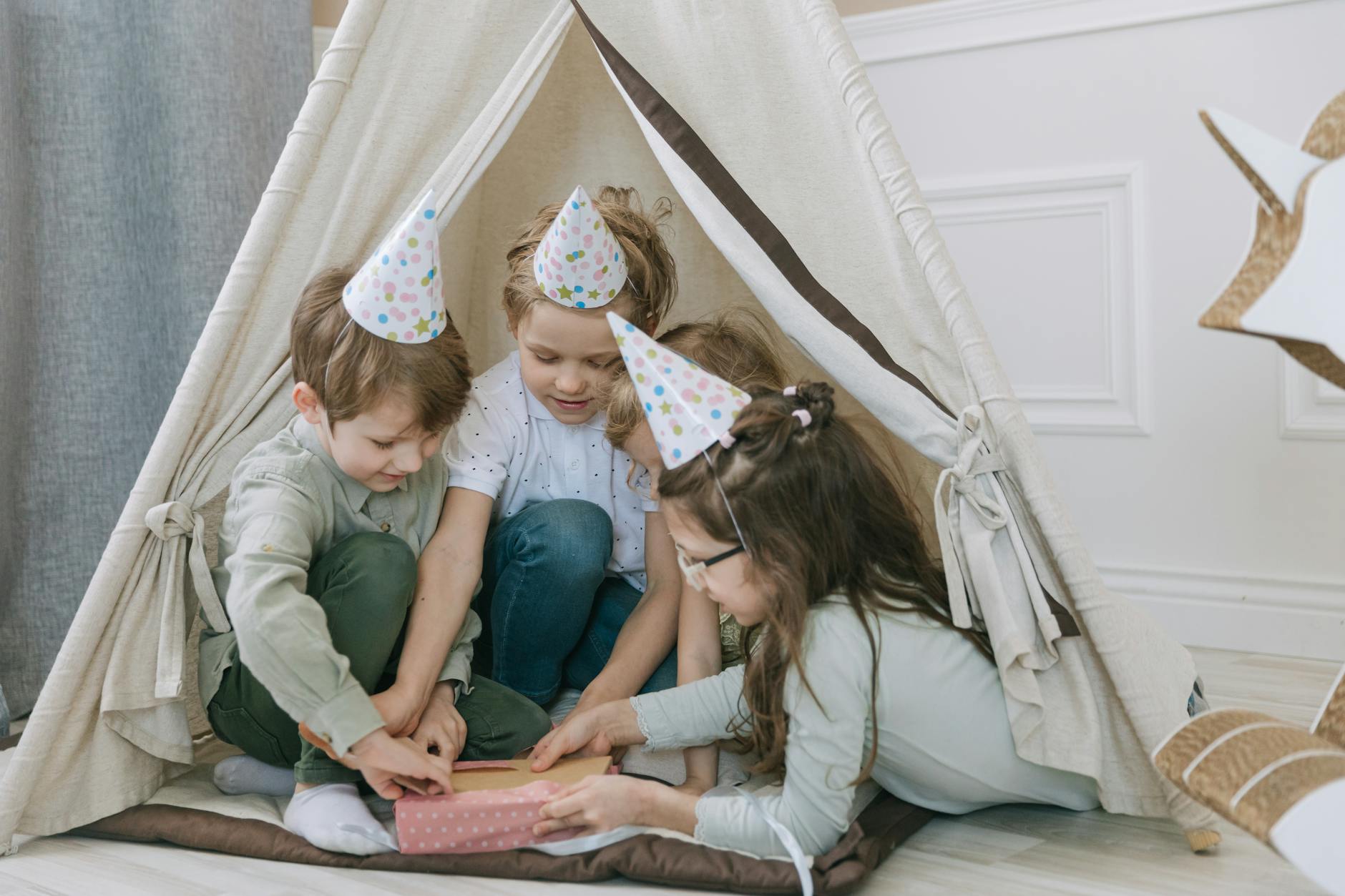
The scene replays itself at practically every kids party. Twenty wrapped presents are stacked on a table near the door. The birthday child’s friends keep sneaking glances at the pile. A dad near the back wonders quietly whether they’re going to do the present thing or not. And the host family hasn’t quite decided.
I have been on both sides of this. With my first, we opened everything at the party. With my third, we took the whole lot home. Both times, people had opinions.
This debate gets more heated than it deserves to be, partly because parents conflate personal preference with etiquette rules, and partly because what’s “normal” depends entirely on where you grew up. So here’s what I actually found when I dug into the research, talked to other parents, and stopped treating this as a moral question.
Jump to
The Case for Opening Gifts at the Party
Opening gifts at the party means the birthday child unwraps presents in front of guests, typically after cake and games. In the US and Australia, this has been the default for most of the 20th century.
Daniel Post Senning, an etiquette expert with the Emily Post Institute, makes a strong argument for keeping the tradition. In an interview with Scary Mommy (August 2023), he described the gift-opening moment as “a real learning opportunity” and “a chance for growth and development.” His point is not sentimental. He argues that gift exchange at a party, done well, teaches children how to give thoughtfully, receive graciously, and thank someone in the moment. You can’t learn those things if you practise them privately at home after guests have left.
There’s also a practical case. Dr. Mini Tandon, a child and adolescent psychiatrist at St. Louis Children’s Hospital affiliated with Washington University, notes that opening gifts can add structure to a party and give it a natural ending point. Parties for younger kids sometimes lose momentum after cake, and having a defined activity to close things out helps both children and parents.
From the gift-giver’s side, many parents report genuine frustration when presents are not opened. Half the reason a seven-year-old spends three weeks deciding on the perfect present for their best friend is to watch their face when they open it. Removing that moment takes something away from the guest too, not just the birthday child.
The Case Against Opening at the Party
The argument for skipping the in-party opening is also legitimate, and it’s gaining ground. A 2024 poll by What to Expect, surveying 404 parents in the US, found that 13% now put “no gifts” on their children’s party invitations, up from near zero a decade ago. That same survey found 97% of parents still buy gifts when invited, which tells you gift culture hasn’t disappeared. It’s just that the public unwrapping ceremony is being quietly dropped.
There are three real reasons parents make this call.
First: the inequality problem. If one child at the party couldn’t afford to bring a gift, or forgot it at home, the public opening turns that into a visible moment. A thread on Motherly from 2024 captured thousands of comments on this, with parents saying the single biggest reason they’d switched was protecting children who came from families under financial pressure. “We don’t want to embarrass them,” one parent wrote, and that’s a direct act of kindness toward another family.
Second: the chaos problem. With large parties, fifteen-plus children crowded around a table while one child rips through paper is genuinely exhausting. Presents get broken, pieces get lost, and the birthday child often becomes overstimulated before they’ve fully registered half of what they received. Angela J. Narayan, a child psychologist at the University of Denver, wrote in The Conversation in December 2025 that small children face compounding demands during gift opening: containing excitement, delaying gratification, reacting positively to surprises, and saying something polite all at once. For a five-year-old, that’s a lot.
Third: the thank-you note problem. When presents pile up unopened at a party, you need a reliable system to track who gave what. Many parents who open at home say they can give each gift proper attention and write more personal thank-you notes as a result.
What Different Cultures Do
The US and Australia both have a strong default toward opening gifts at parties, though Australia is slightly more variable. In the UK, the tradition runs in a completely different direction. Sarah, a British-born party planner cited in Ask The Party Fairy (an American party planning blog), described UK children’s parties as “much like weddings” where “gifts are presented in honour of the occasion but never opened in front of guests.” Thank-you cards follow later.
East Asia takes the UK approach further. In Japan, it is customary to wait until the giver has left before opening a gift. Offering and receiving with both hands is a mark of respect. The assumption is that opening a gift in front of the giver puts both parties in an uncomfortable position. There’s no expected performance of delight, because the performance itself would feel uncomfortable. A 2022 study published in Psychological Science, co-authored by researchers at UC Davis and the University of Tokyo, found that Japanese children waited three times longer than US children when asked to delay opening a gift. The researchers linked this directly to cultural habits: Japanese children are socialised to wait, while US children are specifically conditioned around the ritualised anticipation of gift opening.
China has a similar approach. Opening a gift immediately in front of the giver is generally considered impolite, regardless of age. Turkey is the opposite. Gifts there are opened immediately with visible enthusiasm, similar to the US default.
Germany has a practical twist: birthday hosts are traditionally expected to organise their own party and pay for it. If you’re attending a German birthday, you might find the birthday person handing you a drink rather than the other way around.
None of these norms are correct. They’re culturally loaded, and they shift. What’s worth knowing is that if your child attends a party hosted by a family from a different background, their approach to the present pile is probably intentional, not rude.
What Child Experts Actually Say
The research doesn’t give a clean verdict, but it does point toward a few things worth taking seriously.
Dr. Mini Tandon at St. Louis Children’s Hospital makes the point that gift opening at parties can go “in many different directions,” and the most useful question is whether you’ve prepared your child for it. A child who has been briefed on what to say when they receive something they already own is going to handle the moment much better than one who hasn’t.
Angela Narayan at the University of Denver noted in 2025 that “we expect small children to contain their excitement, delay gratification and react positively to the surprise” and that these are “all complex requests, rarely directly or explicitly taught.” Her practical recommendation is preparation. Role-play gift opening before the party. Give your child the specific words to use. “Thank you, I love it” is enough.
The UC Davis and University of Tokyo study from 2022, published in Psychological Science, adds a useful angle. Children’s ability to delay gratification is shaped by the cultural habits around them. US children are conditioned to wait for gifts, so they do it well. That conditioning only happens if parents actually build the ritual in. Skipping the public opening every time might mean your child never practises the social skill at all.
Daniel Post Senning put it plainly: “If you throw your hands up and say this is hard, we’re going to skip it, you’re skipping the opportunity to have those experiences in a structured and controlled environment.”
That doesn’t mean you should do it when it’s genuinely going to end in tears. Age matters. For children under four, opening gifts at a large party is often too much stimulation. For a six-year-old with ten close friends who helped choose the gifts? The moment can be warm and memorable for everyone.
How to Handle It Either Way
If you open gifts at the party:
- Prep your child the day before, not the morning of. Cover what to say when they receive something they already have, what to say when they don’t recognise what it is, and why each person in the room took the time to bring something.
- Keep the guest list to a manageable size. Post Senning suggests 15 children is too many for a four-year-old’s gift opening to go well.
- Have someone else track who gave what while you supervise the opening.
- Open after cake, as the last activity of the party.
If you open gifts after the party:
- Tell guests at the start, or put it on the invitation. Don’t leave it ambiguous.
- Send personal thank-you messages within a week, ideally with a photo of the child with the gift.
- A voice note or video from a young child means more than a written card. A simple text with a photo is fine for informal friendships.
The one thing both approaches require: your child needs to connect the gift to the person who gave it. Whether that happens at the party or over the following days matters less than whether it happens at all.
If you’re still planning the party itself, I’ve put together a big list of birthday party ideas for kids covering everything from themes to timings. And if you’re shopping for a child you don’t know that well, there are practical gift ideas for a new friend at different price points.
Frequently Asked Questions
Is it rude not to open gifts at a birthday party?
Not opening gifts at a party is not inherently rude, but how you handle the situation matters. In the US and Australia, many guests arrive with children who are excited to see their present opened, so a brief explanation helps. Something like “we open at home so we can give each gift proper attention” takes the awkwardness out of it. In the UK and most of East Asia, not opening at the party is the default and requires no explanation at all. The issue arises when presents quietly disappear without any acknowledgement. If you don’t open gifts at the party, personal thank-you messages within the week are not optional.
At what age should a child start opening gifts at their party?
Most child development guidance points to somewhere between five and seven as the age when children can reliably manage the social demands of public gift opening: staying seated, responding graciously, and not saying something that embarrasses both parties. Dr. Mini Tandon at St. Louis Children’s Hospital suggests considering the specific child’s temperament and what they’ve been coached to expect. A mature four-year-old who has practised can do it well. An overwhelmed seven-year-old at a party of twenty kids might not. Age is a guide, not a rule.
What should a child say when they open a gift they already have?
The simplest and most honest thing is: “Thank you so much, I really love this!” Leave it there. For older children, you can add “I’m so happy you came.” What they should not say is “I already have one” or “I don’t like this kind.” This is worth practising out loud before the party, not just mentioning in passing. A brief role-play, where you hand your child a wrapped box and ask them to respond, works better than a conversation about it. Children need the words in their mouth, not just their head.
Why do some parents now skip gifts altogether?
The “no gifts” trend has grown for three reasons. Financial pressure is real: a 2024 What to Expect poll (404 parents in the US) found the average spend at a child’s birthday party is around USD 5 to 0 (approximately AUD 8 to 6), and for families attending multiple parties a month, that adds up. Environmental concern is a second driver, with many parents not wanting more plastic toys in the house. The third reason is social pressure. A UK survey by No Crap Parties (January 2024, 343 parents) found 81% of parents always buy gifts for other children’s parties, but a large proportion feel pressure to do so even when they’d prefer alternatives. Encouraging donations to charity, asking for books, or requesting experiences rather than objects are all becoming more common.
Should you open gifts at a venue party?
Venue parties with a fixed time slot (trampoline parks, bowling alleys, soft play centres) often don’t have room in the schedule for gift opening. Most parents skip it entirely in these cases, and most guests expect as much. If you want to acknowledge gifts on the day, a brief moment where the birthday child thanks everyone collectively works well. The formal opening happens at home later, and a follow-up message to each family is enough. The venue context makes the decision for you in many cases: there’s nowhere clean to sit, the noise makes it impractical, and the children want to keep playing rather than watch a present-opening ceremony.