
Last year I planned a surprise 40th for my husband. The party itself went well. The six weeks before it? Absolute chaos. Someone almost texted him the WhatsApp group link, his mum came close to saying “see you Saturday” two weeks early, and I spent an entire Tuesday trying to figure out how to get him to a restaurant he’d never heard of without raising suspicion.
Surprise parties are one of the most rewarding things you can do for someone. According to a 2023 YouGov poll of 1,000 adults, 59% of Americans have attended a surprise party, and they rank among the most beloved celebrations people experience. But they are also the one type of party where poor planning doesn’t just mean an underwhelming event. It can spoil the whole thing.
This guide covers every step, from picking a date six weeks out to choreographing the reveal moment. No fluff, no generic tips. Just what works.
TL;DR
- Start planning 4-6 weeks out. Anything less and RSVPs become stressful.
- Your single biggest job is keeping the secret. Everything else is standard party planning.
- Pick one trustworthy person as the decoy. Brief them in detail.
- Send invites 3-4 weeks out via a private channel (group chat or email, never paper).
- The reveal moment needs a plan. Spontaneous chaos is memorable for the wrong reasons.
- Budget: the average adult surprise party runs $500-$1,185 USD ($780-$1,820 AUD) depending on guest count and venue (Peerspace survey, 2025).
What makes a surprise party memorable isn’t whether the reveal went to plan. It’s the fact that twenty people kept a secret for a month because they cared enough to bother.
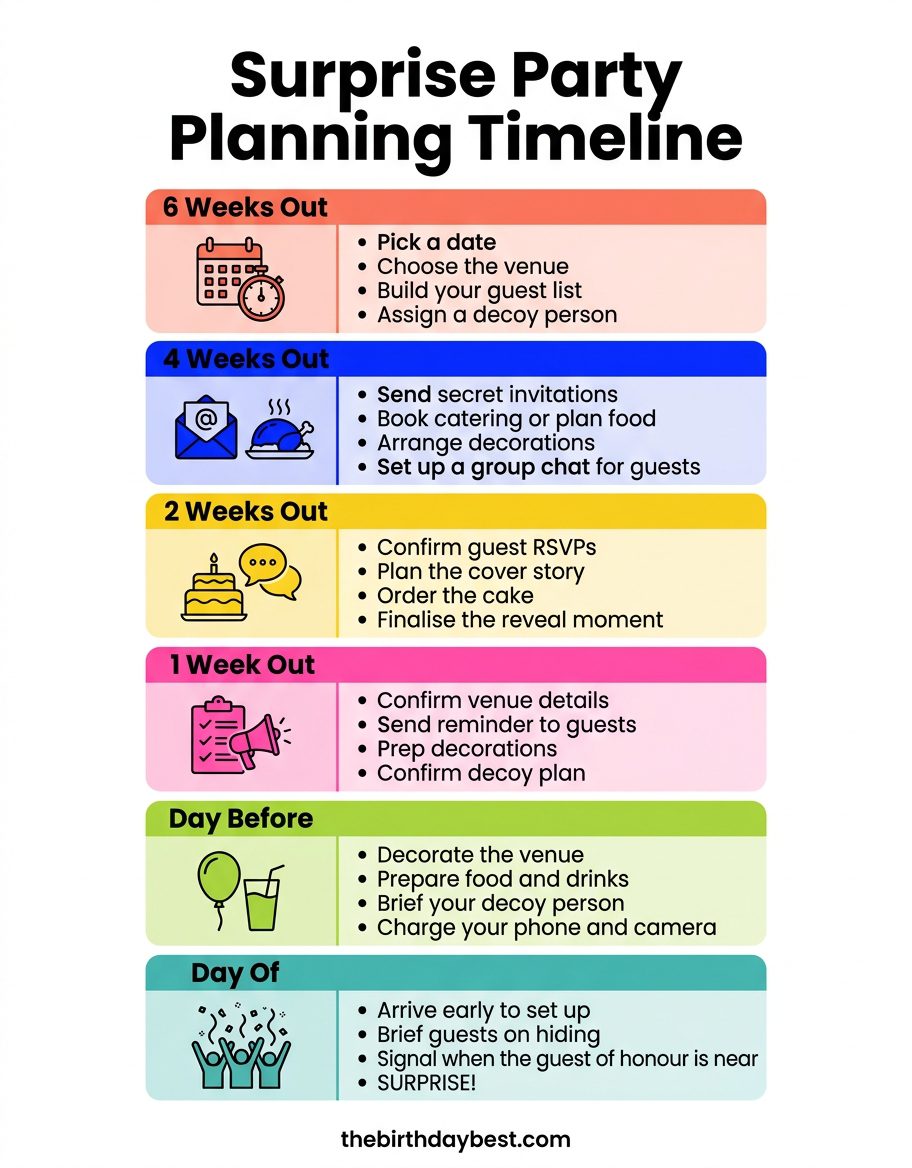
What You Will Need Before You Start
A surprise party has two planning tracks running at the same time: the logistics track (venue, food, guests) and the secrecy track (decoy plan, cover story, guest communication). Most people focus on logistics and then scramble on secrecy. The result is a party that’s beautifully decorated but falls apart because the decoy panicked, the guest list has a leaker, or nobody told guests what time to arrive by. Both tracks need attention from the start. Before you plan a single detail, have these four things confirmed: a decoy person, a private communication channel, a working budget, and a genuine sense of whether the guest of honour wants a surprise at all.
Break those four down:
- A confirmed decoy person. The decoy is the person who keeps the guest of honour occupied and delivers them to the venue at the right time. They need two qualities: they must be trusted by the guest of honour, and they must be a convincing actor. A poor decoy sinks the whole party.
- A private communication channel. WhatsApp group, Signal, or a secret Facebook event. Never paper invitations. Never standard email with a subject line the guest of honour might see.
- A budget. The average adult birthday party costs $500-$1,185 USD ($780-$1,820 AUD), with food and drinks accounting for 38% of that total (Peerspace, 2025 survey of 1,000 adults). Know your number before booking anything.
- An honest read on the guest of honour. Does this person want a surprise? Some people don’t. A 2023 YouGov poll found 59% of Americans have attended a surprise party, but preferences vary. If they have ever said “I’d hate a surprise party,” believe them.
Step 1: Set the Date (6 Weeks Out)
A surprise party works best when it falls 1-3 weeks before the actual birthday. This is counterintuitive, but it raises the chance of a genuine surprise. If the party falls on the birthday weekend, they’ll be expecting something. Scheduling it a little early lowers their guard.
Confirm three things before locking a date: the guest of honour’s calendar (without tipping them off), the availability of your key guests, and the venue’s schedule. Social Tables recommends at least 3 weeks of lead time for groups under 25, and 6 weeks for larger gatherings. Six weeks is the comfortable zone for most people, because the first week is mostly just sorting the guest list and venue.
Step 2: Choose the Venue
The venue needs to satisfy one condition: the guest of honour cannot have a reason to be there before the party starts.
Best options, in order of ease:
- A friend’s home they don’t visit often. Easy to decorate in advance, parking is manageable, no room hire fee.
- A private room at a restaurant they like. They’ll accept the cover story (“we’re going for dinner”), setup is handled, and cost is predictable. Book at least 4 weeks out for popular venues.
- A hired venue or function room. More expensive ($200-$600 AUD / $130-$390 USD for room hire alone), but gives full control over setup and noise.
Sort out parking before you send invitations. If 20 familiar cars are lined up outside when the guest of honour pulls up, the surprise is over. Ask guests to park one street away, use a nearby car park, or arrive by rideshare.
Step 3: Build Your Guest List and Send Secret Invitations (4 Weeks Out)
A surprise party guest list needs a vetting step that regular parties don’t. You’re not just asking who to invite. You’re asking who can keep a secret for four weeks.
Think about each person on your list. The friend who always blurts things out? Either don’t invite them, or hold off telling them it’s a surprise until two days before. The guest of honour’s mum, sibling, or closest colleague who speaks to them every day? Brief those people with specific instructions: what not to say, when not to say it, and how to respond if the guest of honour mentions the date.
Paperless Post recommends sending invitations 4 weeks before the event, which gives guests enough time to clear their schedules but not so much time that slips become likely. The invitation must make three things clear: this is a surprise, don’t contact the guest of honour about this, and arrive by a specific time (15 minutes before the guest of honour is due). That last part matters. Guests arriving late after the reveal is fine. Guests arriving during the reveal is not.
Step 4: Build the Cover Story (3 Weeks Out)
A cover story is the false reason your decoy gives the guest of honour for going to the party venue. It needs to be believable enough that the guest of honour doesn’t ask too many follow-up questions, specific enough to feel real, and simple enough that your decoy can maintain it under pressure. It also needs to account for dress code: if the party is a smart dinner and the cover story is “a casual catch-up,” the guest of honour walks in dressed for the wrong occasion. That moment of embarrassment takes the shine off the reveal. Three criteria matter:
- Plausible. “Let’s grab dinner at that new place” works. “Come to a mystery address in a suburb you’ve never been to” does not.
- Dress-code compatible. If the party is a smart dinner and the cover story is “just a casual lunch,” your guest of honour arrives underdressed and embarrassed. Align the outfit expectation with the decoy plan.
- Simple, not elaborate. The more complex the cover story, the more it can unravel. “We’re going for dinner, I made a booking” is harder to poke holes in than a multi-part fake itinerary.
Fun Services Midwest, an event planning company with experience across hundreds of surprise events, warns against making the decoy plan too exciting. If you tell someone “I have front-row concert tickets,” and it turns out to be a party, they feel a sting of disappointment even when the party is wonderful. The decoy plan should be pleasant, not thrilling.
Step 5: Plan the Food, Cake, and Decorations (2-3 Weeks Out)
For a surprise party, the food and decoration logistics are the same as any party. The key difference: everything must be in place before the guest of honour walks in, which means your setup window is fixed. Work backwards from their arrival time and add a 30-minute buffer.
Food accounts for 38% of the average party budget, according to Peerspace’s 2025 survey of 1,000 adults. For a 20-person party with a $500 USD ($780 AUD) budget, that’s roughly $190 USD ($295 AUD) on food and drinks. Catered platters or grazing boards work well because they don’t need attention once set out. Order the cake at least two weeks out, and confirm the venue will allow an external cake (most do, but not all).
For a complete breakdown of what to buy, what gets forgotten, and what to order well in advance, the birthday party supplies checklist on this site covers it all.
Step 6: Brief Your Guests (The Week Before)
This is when things start to feel real, and when most people slip up.
Send a reminder to all guests with the full timeline: their arrival time, when the guest of honour is due, where to stand or hide, and who to contact if they’re running late. Assign specific roles: one lookout (watches for the guest of honour’s arrival and gives the signal), one corraller (gets everyone into position on the signal), and one person with a phone charged and ready to record video.
Run through contingencies with your decoy: what if the guest of honour is 30 minutes late? What if they want to cancel and stay home? What if a friend spots a familiar car and texts them? Having answers before the day means your decoy doesn’t have to improvise under pressure.
Step 7: The Day Before
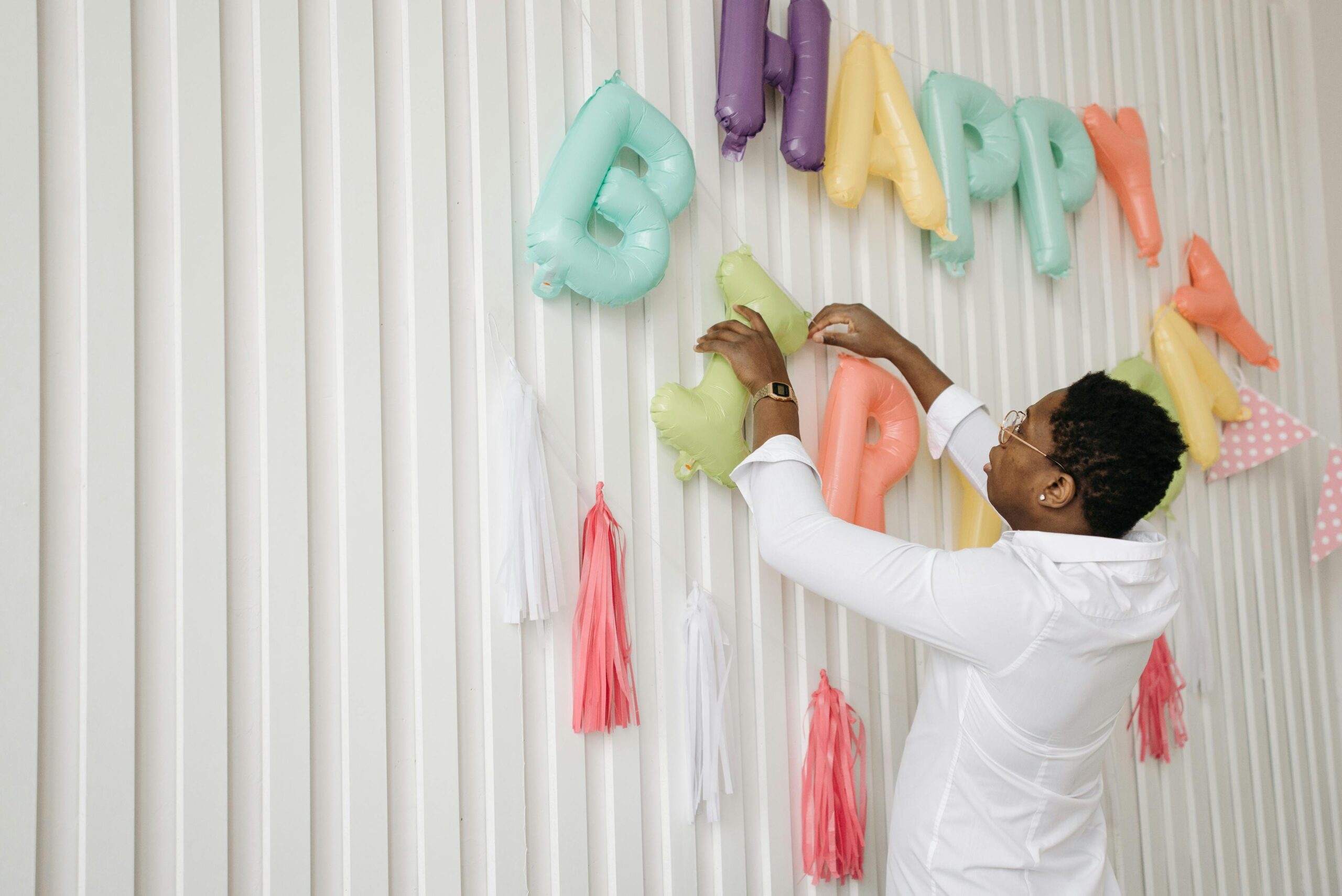
If the venue allows it, decorate the night before. This removes the biggest time pressure from the day itself. Set up everything except food, and take a photo of the finished venue so you can see what needs adjusting when you return.
Brief your decoy one final time. Confirm the pickup time, the route, and what they’ll say if the guest of honour suggests staying home instead. Your decoy needs a prepared response to that specific scenario because it comes up more than you’d expect.
Step 8: The Day Of, and the Reveal
Arrive at least 45 minutes before guests are due, and 90 minutes before the guest of honour. Get food and final decorations in place. Brief guests on their roles. Designate one person to receive live updates from the decoy and pass them to the room.
Plan the reveal in advance. The Birthday Butler blog describes a common scenario: weeks of careful planning, followed by near-chaos in the final two minutes because no one had agreed on who starts the shout, where people stand, or who films the reaction. They still managed the surprise, but only just.
Decide in advance: does everyone shout “Surprise!” together on a signal, or do guests emerge one by one for a more personal moment? Lights off then on, or everyone visible from the entrance? Who films, and from which angle? Position the person the guest of honour will most want to see right where they’ll spot them first. That initial 30 seconds is the memory they carry forward.

Common Mistakes (and How to Avoid Them)
Telling too many people. Every additional person you tell is another potential leak. Limit the early circle to whoever is needed to organise the party. Others find out when the invitation arrives, and the invitation makes the stakes clear.
Sending invitations too early. Four weeks is the right window. Six weeks is too long. Over time, people forget the weight of secrecy, drop casual references in conversation, and slip.
A cover story that doesn’t match the dress code. If the party is smart casual and the decoy says “just a walk,” the guest of honour arrives in activewear. A simple note from the decoy: “I’ve made a booking, dress nice” solves this.
No signal system. When the guest of honour is two minutes away, you need everyone off their phones, in position, and quiet. One text from the lookout, “2 mins,” is the cue. Without that, it’s a scramble.
No plan for the first five minutes after the reveal. That moment can go quiet fast. Guests look to each other, unsure what to do, while the guest of honour processes what just happened. Have music playing when they walk in. Have drinks poured and ready to pass immediately. Assign one person to step forward, welcome the guest of honour warmly, and move the energy from reveal into celebration. Without that transition, 30 people can end up standing in silence for an awkward minute. It’s avoidable with a small amount of advance thought.
Still working out what kind of party to build the surprise around? The best birthday party ideas for adults covers the full range, from themed dinners to experience-based celebrations worth the effort.
Frequently Asked Questions
How far in advance should you plan a surprise birthday party?
For a group of under 25, three weeks is workable. For 25 or more guests, give yourself six weeks. The limiting factor is getting RSVPs confirmed while the secret holds: more guests means more coordination and more potential leaks. Four to six weeks is the zone that gives you enough lead time without the secret getting stale.
How do you keep a surprise party secret?
Three things make the difference. First, limit the early circle to people who need to know for planning purposes. Second, use a private digital channel and never paper or standard email. Third, brief every guest with specific instructions: this is a surprise, don’t contact [name] about this, arrive 15 minutes before the guest of honour, and here’s what to say if they ask about the date. The more specific the brief, the less improvisation happens.
What is a good cover story for a surprise party?
The best cover stories are simple, believable, and aligned with how the guest of honour will need to be dressed. “Dinner at [restaurant]” works better than elaborate fake events because it’s harder to question. The decoy should be someone the guest of honour makes plans with regularly, so the invitation doesn’t feel unusual. Avoid making the fake plan sound exciting: if the guest of honour later realises it was fiction, a too-good cover story creates a faint sense of letdown.
How much does a surprise birthday party cost?
The average adult birthday party costs $500-$1,185 USD ($780-$1,820 AUD), with a median closer to $500 USD, according to Peerspace’s 2025 survey of 1,000 adults. Food and drinks account for about 38% of that. A home-based party for 20 people can come in under $300 USD ($470 AUD) if you handle catering. A private room at a restaurant adds room hire ($130-$390 USD / $200-$600 AUD) but removes most setup work. For ideas across different price points, the birthday experience gifts guide has options that double as both the party and the present.
What should I do if the surprise gets ruined?
Keep going. A ruined surprise does not ruin the party. If the guest of honour finds out a day early, they lose the initial shock but still get a room full of people who bothered to show up. If they find out on the day, lean into it: “we’re all here because we wanted to celebrate you properly.” I have known people who preferred knowing in advance because it gave them time to prepare emotionally. The gathering is the gift. The secrecy is just the packaging.