
When my youngest was about seven, she went through a phase of collecting phrases in other languages. Not whole sentences. Just greetings. She’d come home from school with a new one scrawled on her hand: “how do you say hello in Japanese?” or “what’s thank you in Italian?” The one that stuck longest was happy birthday. She wanted to know it in every language she could find.
I got completely swept up in it. What started as a school project turned into a months-long rabbit hole for both of us: sticky notes on the fridge, birthday cards written in three scripts, and more than a few garbled attempts at Mandarin pronunciation over the dinner table. That curiosity has never really left me. If you’ve ever wanted to wish someone a happy birthday in their first language, or you’re just someone who finds this stuff as interesting as I do, this is the resource I wish I’d had back then.
TL;DR
- The top 20 languages by global speaker count are covered below with native script, romanisation, and a plain-English pronunciation guide.
- A quick-reference table with all 217 languages follows for fast lookups.
- Some countries don’t traditionally celebrate birthdays at all. Jehovah’s Witnesses globally, and historically in parts of the Middle East and East Asia, birthdays weren’t marked the way Western cultures do.
- Mandarin, Spanish, and Arabic are the three most widely spoken languages outside English, and learning the greeting in even one of them is worth it if you have friends or family who speak it.
Why saying it in someone’s language matters
A birthday greeting in someone’s mother tongue lands differently from a translation app paste. I noticed this the first time I wished my neighbour (she’s from Vietnam) a happy birthday in Vietnamese. She laughed, then teared up slightly. It wasn’t because my pronunciation was good (it wasn’t). It was because I’d tried.
Language is personal in a way that nothing else quite is. According to research published by the Ethnologue language database, there are approximately 7,168 living languages in the world as of 2024. Most people spend their whole lives fluent in only one or two. When someone makes the effort to reach across that gap, even just for a birthday, and it registers.
This matters even more at birthday time because birthdays are already emotionally loaded. The effort multiplies the warmth. And if the language thing gets you in the mood to plan something special, the birthday party ideas for adults I’ve pulled together cover everything from backyard dinners to full celebrations worth doing in someone’s honour.
Happy Birthday in the Top 20 Languages: The Deep Guide
These are the 20 most widely spoken languages by total speaker count, per the Ethnologue 2024 rankings. For each one, I’ve included the native script, a standard romanisation, and a simple pronunciation guide written phonetically. No linguistics degree needed.
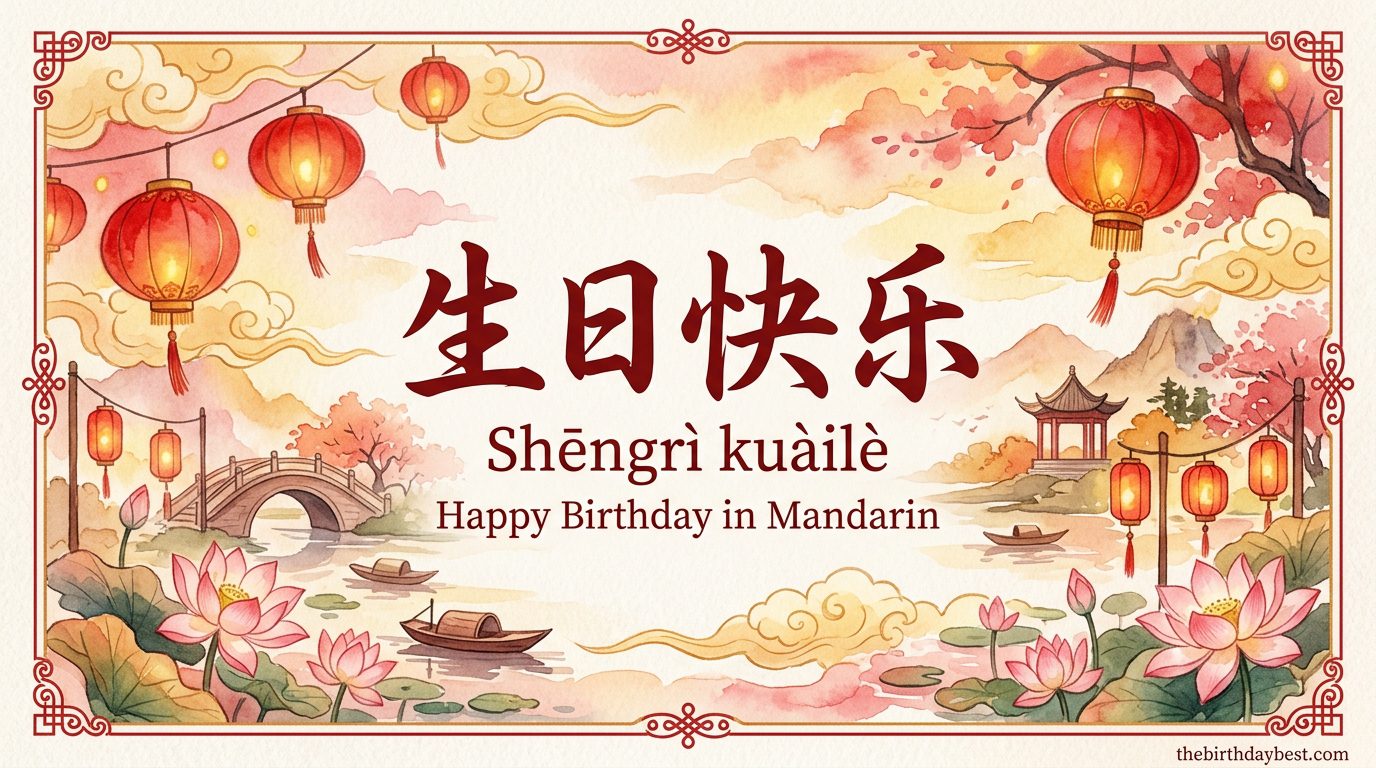
1. Mandarin Chinese: 生日快乐
Native script: 生日快乐
Romanisation: Shēngrì kuàilè
Pronunciation: shung-rr kwai-luh
Formal version: 祝你生日快乐 (Zhù nǐ shēngrì kuàilè), meaning “May you have a happy birthday”
In mainland China, birthday traditions vary by age and region. Children typically receive longevity noodles (长寿面, chángshòu miàn) on their birthdays: a single long noodle symbolising long life, eaten without cutting. Western-style birthday cakes became common in urban areas from the 1990s onwards, but the noodle tradition remains strong in many families. In Chinese culture, the 60th birthday carries particular weight, marking the completion of a full cycle in the Chinese zodiac.
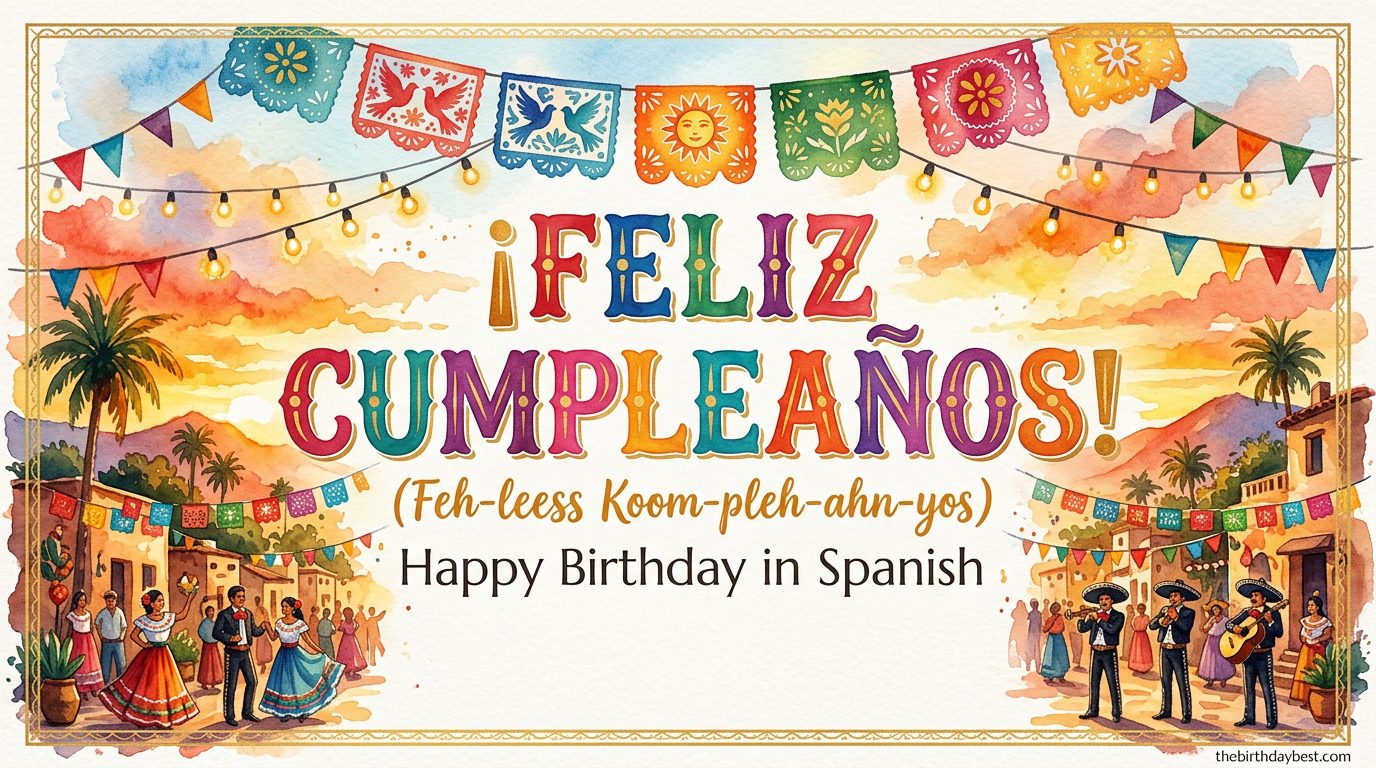
2. Spanish: ¡Feliz Cumpleaños!
Native script: ¡Feliz Cumpleaños!
Pronunciation: feh-LEES koom-pleh-AHN-yos
Regional note: In Mexico and much of Latin America, “Las Mañanitas” is the traditional birthday song, not “Happy Birthday”. It dates to the 16th century and is still sung at dawn or early morning as a surprise.
The piñata is arguably Mexico’s most globally recognised birthday tradition. Originally from Spanish colonial culture with roots in Italian and Chinese custom, the seven-pointed star piñata is said to represent the seven deadly sins, and breaking it symbolises the defeat of temptation. Most people don’t think about that theology when they’re whacking one at a kid’s party, but the history runs deep.
3. English: Happy Birthday
Pronunciation: hap-ee burz-day
Origin: The melody of “Happy Birthday to You” comes from “Good Morning to All”, written by American sisters Mildred and Patty Hill in 1893. The birthday lyrics were added later. Warner/Chappell Music held the copyright until 2016, when a US federal court ruled it in the public domain, ending decades of licensing fees that reportedly earned the company $2 million USD per year.
4. Hindi: जन्मदिन मुबारक
Native script: जन्मदिन मुबारक
Romanisation: Janmadin Mubarak
Pronunciation: JUN-muh-din moo-BAR-uk
Alternative: Happy Birthday (हैप्पी बर्थडे) is also widely used in urban India, particularly among younger generations.
In many Hindu families, birthdays are celebrated by visiting a temple in the morning, receiving blessings, and distributing sweets to neighbours and friends. The English-style birthday party with cake has become standard in Indian cities over the last 30 years, often running alongside these older customs rather than replacing them.
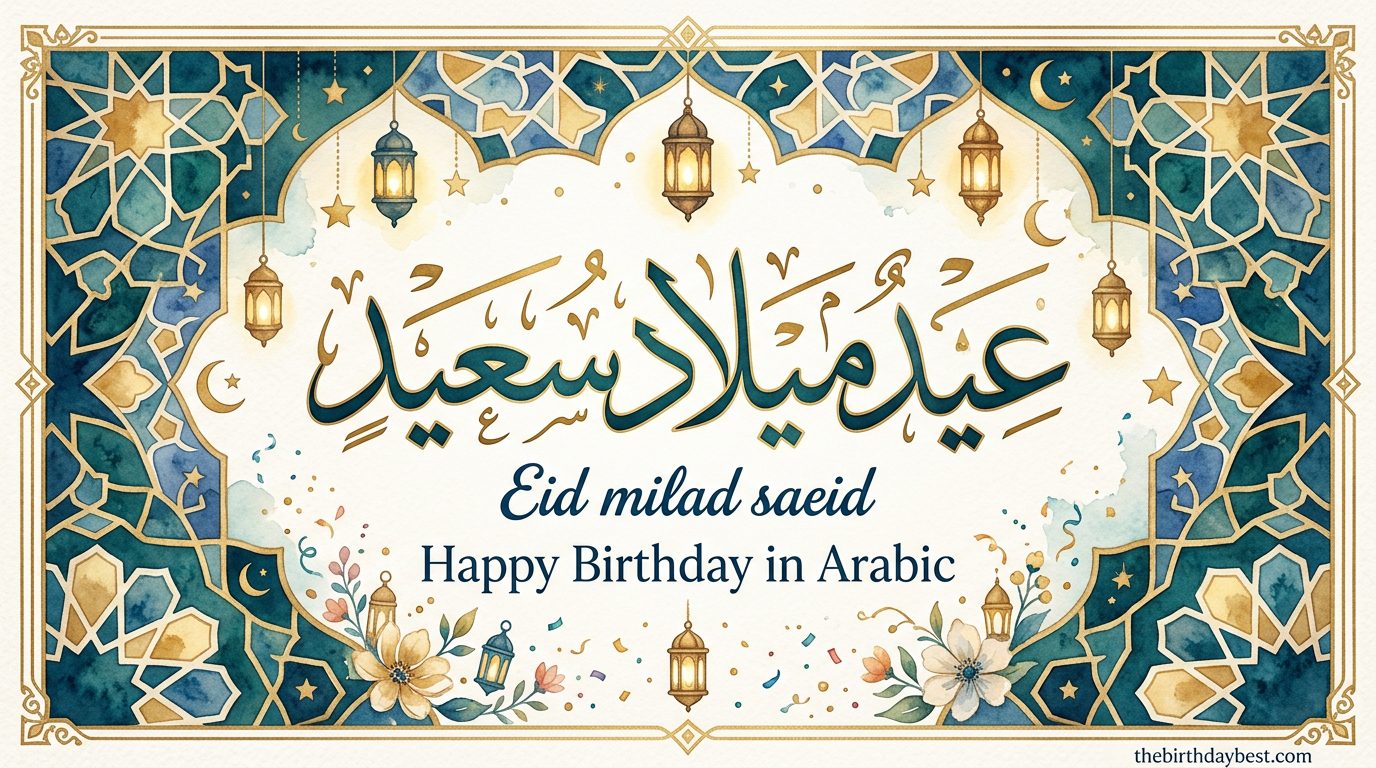
5. Arabic: عيد ميلاد سعيد
Native script: عيد ميلاد سعيد
Romanisation: Eid milad sa’id
Pronunciation: EED mee-LAD sah-EED
Egyptian dialect: كل سنة وأنت طيب (Kol sana wenta tayyeb): “May every year find you well”. This is more common in colloquial Egyptian Arabic and is widely used across the Arab world.
Birthday celebrations were historically less prominent in traditional Islamic culture than in Western cultures, and some conservative interpretations still discourage them as a foreign custom. In practice, birthday parties are now widespread across the Arab world, particularly in urban areas, with Egypt, Lebanon, and the Gulf states having well-established party cultures.
6. Bengali: শুভ জন্মদিন
Native script: শুভ জন্মদিন
Romanisation: Shubho Janmodin
Pronunciation: SHOO-bho JON-mo-din
Bengali birthday celebrations often begin with a ritual bath, after which the birthday person receives blessings from elders. Payesh, a sweet rice pudding made with milk and date palm jaggery, is the traditional birthday food in many Bengali households, both in West Bengal (India) and Bangladesh. The smell of payesh cooking is, for many Bengalis, inseparable from the memory of childhood birthdays.
7. Portuguese: Feliz Aniversário
Native script: Feliz Aniversário
Pronunciation: feh-LEES ah-nee-ver-SAH-ree-oh
Brazilian variant: Parabéns pra você (pah-rah-BENS pra voh-SAY), from the popular birthday song “Parabéns a Você”, which is what Brazilians actually sing at parties.
Brazil’s birthday culture is celebratory on a scale that surprises many visitors. Birthday parties, called “festas de aniversário”, are major events even for children: full catering, with, professional decoration, and sometimes hundreds of guests. Brigadeiros (chocolate truffles) are the non-negotiable birthday sweet. You’ll find them at every Brazilian birthday party, regardless of age, budget, or location.
8. Russian: С Днём Рождения
Native script: С Днём Рождения
Romanisation: S Dnyom Rozhdeniya
Pronunciation: s DNYOM rozh-DEN-ee-ya
Russian birthday superstition holds that you should never congratulate someone before their actual birthday. Doing so is considered bad luck. This is taken seriously: Russians won’t say happy birthday a day early, won’t send early cards, and won’t attend advance parties in someone’s honour. The birthday person also traditionally provides their own celebration, bringing food and cake to share with friends or colleagues rather than receiving it from others.
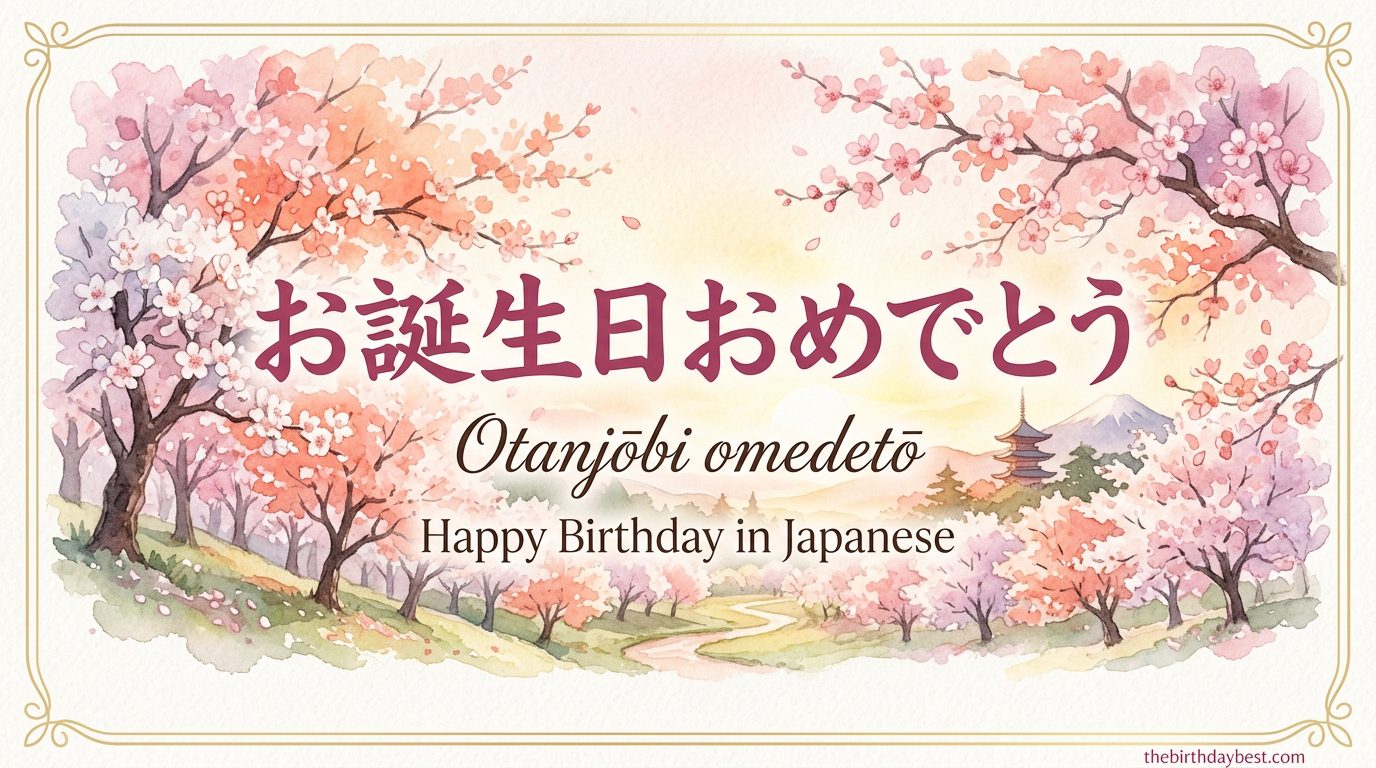
9. Japanese: お誕生日おめでとうございます
Native script: お誕生日おめでとうございます
Romanisation: Otanjoubi omedetou gozaimasu
Pronunciation: oh-tan-JOH-bee oh-meh-DEH-toh go-ZAI-mas
Casual: 誕生日おめでとう (Tanjoubi omedetou), pronounced “oh-tan-JOH-bee oh-meh-DEH-toh”
Japan’s relationship with birthdays has shifted dramatically over the last century. Before 1948, Japan used a system called kazoedoshi, where everyone aged one year on New Year’s Day rather than on their individual birthday, meaning personal birthdays weren’t celebrated at all. The Western birthday tradition was introduced post-war and is now standard, particularly for children. Christmas cake is, curiously, also a birthday staple. Japan’s tradition of celebrating Christmas with strawberry shortcake (from the Fujiya confectionery company’s 1922 marketing campaign) crossed over into birthday culture.
10. Punjabi: ਜਨਮ ਦਿਨ ਮੁਬਾਰਕ
Native script: ਜਨਮ ਦਿਨ ਮੁਬਾਰਕ (Gurmukhi script)
Romanisation: Janam Din Mubarak
Pronunciation: JA-num din moo-BAR-uk
Punjabi is the first language of approximately 125 million people, primarily in the Punjab region spanning Pakistan and India, and in large diaspora communities in Canada, the UK, and Australia. Birthday celebrations in Punjabi culture tend to be communal and generous. Food is central, langar (community kitchen) culture from the Sikh tradition means feeding others on one’s own occasion is considered auspicious.
11. German: Alles Gute zum Geburtstag
Native script: Alles Gute zum Geburtstag
Pronunciation: AL-les GOO-tuh tsoom geh-BURTS-tahk
Shorter version: Herzlichen Glückwunsch (HERTS-lee-chen GLOO-kwunsh), meaning “Heartfelt congratulations”, is equally common.
Germany has its own version of the early-congratulations superstition: wishing someone happy birthday before the day is called “gratulieren vor dem Geburtstag” and is considered bad luck in many regions. Germans take this seriously enough that colleagues will deliberately wait until the actual date to say anything, sometimes causing awkward silences when someone’s birthday falls on a weekend and the workplace party is held the Friday before.
12. Korean: 생일 축하해요
Native script: 생일 축하해요
Romanisation: Saengil chukahaeyo
Pronunciation: SENG-il choo-KA-heh-yoh
Formal: 생일을 축하드립니다 (Saengireul chuka deurimnida)
The traditional Korean birthday food is miyeok-guk (미역국), a seaweed soup that mothers eat after giving birth to restore minerals, and which children eat on their birthday to honour their mother’s labour. Eating miyeok-guk on your birthday is still widely practised, though Korean birthday culture now also includes Western-style cake and the influence of the K-pop industry has made elaborate “fan support” birthday events a cultural phenomenon.
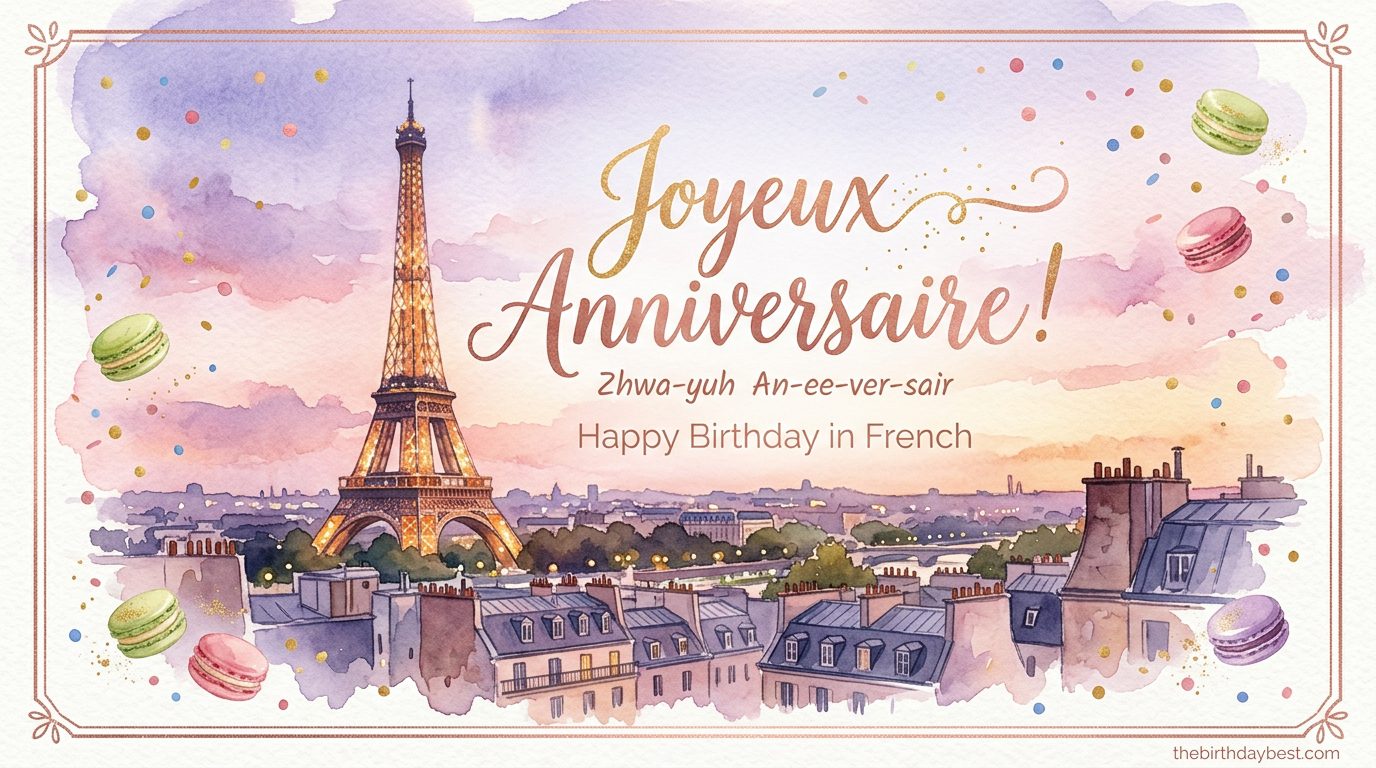
13. French: Joyeux Anniversaire
Native script: Joyeux Anniversaire
Pronunciation: zhwah-YUH ah-nee-ver-SAIR
French is an official language in 29 countries, the most of any language in the world after English. This means “Joyeux Anniversaire” carries across an enormous geographic spread: France, Belgium, Switzerland, Canada, and across much of West and Central Africa including Côte d’Ivoire, Cameroon, and the Democratic Republic of Congo. French birthday customs are relatively low-key compared to Latin American traditions: a meal with family, a cake, candles. The French phrase “gâteau d’anniversaire” (birthday cake) is increasingly just called “le birthday cake” in contemporary French, a linguistic borrowing that French purists have been complaining about for years.
14. Turkish: Doğum Günün Kutlu Olsun
Native script: Doğum Günün Kutlu Olsun
Pronunciation: doh-OOM goo-NOON koot-LOO ol-SOON
Alternative: İyi ki doğdun (ee-YEE kee doh-DOON), meaning “Good that you were born”, commonly used and often sung.
The Turkish birthday song “İyi ki doğdun” is distinct from the Western “Happy Birthday” melody and is the version most Turks actually sing at parties. Birthday traditions in Turkey blend secular Western customs with older Anatolian hospitality culture. The birthday person typically treats guests rather than the other way around, providing food, sweets, and drinks for those who come to celebrate.
15. Italian: Buon Compleanno
Native script: Buon Compleanno
Pronunciation: bwon kom-pleh-AH-no
Also used: Tanti Auguri (TAN-tee ow-GOO-ree), meaning “Many wishes”, used for birthdays and all celebrations, widely sung to the “Happy Birthday” melody in Italian.
In Italy, the birthday person is expected to pay for their own celebration, treating friends to dinner or drinks rather than being treated. This custom, while counterintuitive to people from some other cultures, is considered proper form. Milestone birthdays (18th, 30th, 40th, 50th) are taken particularly seriously and often involve large family gatherings that can run over multiple days.
16. Tamil: பிறந்தநாள் வாழ்த்துக்கள்
Native script: பிறந்தநாள் வாழ்த்துக்கள்
Romanisation: Pirandhanaḷ vāḻttukkaḷ
Pronunciation: pee-RUN-dha-nal VAAZH-thook-ul
Tamil is one of the world’s oldest living classical languages, with a literary tradition stretching back over 2,000 years. Tamil birthday celebrations traditionally include a ritual oil bath, visiting a temple, and receiving blessings from elders. The birthday person typically wears new clothes and distributes sweets. In Tamil Nadu and among Tamil diaspora communities in Sri Lanka, Singapore, Malaysia, and elsewhere, these customs remain strong alongside Western birthday party traditions.
17. Vietnamese: Chúc mừng sinh nhật
Native script: Chúc mừng sinh nhật
Pronunciation: chook moong seen nyut
Vietnamese is a tonal language with six tones, meaning the same syllable said at different pitches carries completely different meanings. This makes pronunciation tricky for non-native speakers. Traditionally, individual birthdays weren’t widely celebrated in Vietnam; Tết (Lunar New Year) served as a collective birthday for everyone, with all people considered to age one year at New Year rather than on their birth date. Individual birthday celebrations became more common through the 20th century, though Tết remains the more significant personal celebration for many Vietnamese families.
18. Urdu: سالگرہ مبارک
Native script: سالگرہ مبارک (written right-to-left)
Romanisation: Salgirah Mubarak
Pronunciation: sal-GEE-rah moo-BAR-uk
Urdu and Hindi share a grammatical structure and are mutually intelligible in spoken form. A native Urdu speaker and a native Hindi speaker can usually understand each other in conversation. The languages diverge in script (Urdu uses a Nastaliq-style Arabic script, Hindi uses Devanagari) and in formal vocabulary. “Salgirah Mubarak” comes from Persian roots, while the Hindi equivalent “Janmadin Mubarak” draws more from Sanskrit.
19. Persian (Farsi): تولدت مبارک
Native script: تولدت مبارک
Romanisation: Tavalladat Mobarak
Pronunciation: tah-val-LAHT moh-BAR-uk
Persian is spoken in Iran, Afghanistan (as Dari), and Tajikistan (as Tajik). The phrase “Tavalladat Mobarak” is standard across all three. Nowruz, the Persian New Year falling on the spring equinox (around 20 March), holds far greater cultural significance than individual birthdays in Iranian culture. Birthday celebrations as a personal milestone are observed, but Nowruz is when families gather, exchange gifts, and mark the passage of time.
20. Polish: Wszystkiego Najlepszego
Native script: Wszystkiego Najlepszego
Pronunciation: fshist-KEH-go ny-LEP-sheh-go
Literal meaning: “All the best”. The full phrase is “Wszystkiego Najlepszego z okazji urodzin” (All the best on the occasion of your birthday), often shortened.
Poland has a parallel celebration system: “imieniny” (name day) are often considered more important than birthdays in traditional Polish culture. Every name in the Polish Catholic calendar has an assigned day, and on that day, friends and family are expected to visit with flowers and small gifts. For many older Poles, imieniny is the bigger occasion. Younger generations tend to treat birthdays as the main event, a shift that has accelerated over the last two decades.

How to Say Happy Birthday Around the World: Infographic

Birthday Traditions Around the World That Surprised Me
The greetings are one thing. But the customs attached to birthdays globally are where it gets genuinely fascinating. A few I keep coming back to:
Ghana: The flour attack
In some Ghanaian communities, particularly in the south, waking up to have flour thrown in your face is the traditional way to mark a birthday. The flour symbolises purity and good fortune. This is distinct from the birthday cake. The flour comes first, usually before the person is even fully awake. Friends and family ambush the birthday person with handfuls of flour or a mix of flour and water. From what I can gather, the birthday person does not always appreciate this.
Denmark: The flag and the window
Danish birthday tradition involves placing the national flag (the Dannebrog) outside the window of the birthday person’s home when they wake up. The flag is left out all day as a public announcement of the occasion. Friends arriving for a party would see the flag and know whose birthday it was from the street. Denmark is one of the few countries where a single household flag-flying custom is so strongly tied to individual celebrations rather than national ones.
Russia: The ear-pulling tradition
In Russia, it’s customary to pull the birthday person’s ear once for each year of their age. This is meant to be affectionate rather than painful (results vary). Children receive ear-pulls at school from classmates; adults might get them from friends. The accompanying phrase is roughly “so you don’t forget how old you are.”
Korea: Dol (돌), the first birthday
In Korean culture, the first birthday (dol, 돌) is one of the most significant occasions in a child’s life. Traditionally, the first year carried high infant mortality risk, so surviving to one year was cause for major celebration. The dol ceremony includes the child being dressed in traditional hanbok and placed before a table of symbolic objects: a book (wisdom), thread (long life), a pencil (scholarship), money (wealth). Whichever object the child reaches for first is believed to predict their future.
Mexico: La Mordida
At Mexican birthday parties, it’s traditional to push the birthday person’s face into the cake (“La Mordida”, meaning “the bite”,) after the candles are blown out. The crowd chants “mordida, mordida!” and the birthday person is expected to take a bite. The resulting face full of frosting is photographed, laughed about, and serves as a kind of initiation into another year. Not every Mexican family does this, and urban practices are shifting, but it remains widespread at children’s parties.
Countries where birthdays weren’t traditionally celebrated
Several cultural and religious groups historically did not mark individual birthdays. Jehovah’s Witnesses worldwide do not celebrate birthdays, viewing the custom as having pagan origins. In early Chinese and Japanese culture, individual birthdays were not observed, since age was calculated communally at New Year. Some Orthodox Jewish communities historically emphasised yahrtzeit (the anniversary of a death) over birthdays, though modern Israeli culture has adopted birthday celebrations enthusiastically. These traditions are shifting, particularly among younger generations in all these communities, but the historical absence of birthday celebrations in cultures that now observe them is a reminder that the custom itself is more recent and more culturally specific than it might seem.
Quick Reference: Happy Birthday in All 217 Languages
This table covers every language in our database. For the top 20, see the detailed sections above, which include pronunciation guides and cultural notes. This table is for fast lookups.
| Language | Happy Birthday (Native Script / Text) | Romanisation / Transliteration |
|---|---|---|
| Afrikaans | Veels Geluk met jou Verjaarsdag | Veels Geluk met jou Verjaarsdag |
| Albanian | Gëzuar Ditëlindjen | Gezuar Ditelindjen |
| Amharic | መልካም የልደት ቀን (Melkam Yeledet Ken) | Melkam Yeledet Ken |
| Arabic | عيد ميلاد سعيد | Eid Milad Sa’id |
| Armenian | Շնորհավոր Ծննդյան | Shnorhavor Tsnndyan |
| Azerbaijani | Ad Günün Mübarək | Ad Gunun Mubarek |
| Basque | Zorionak | Zorionak |
| Belarusian | З Днём Нараджэння | Z Dnyom Naradzhenya |
| Bengali | শুভ জন্মদিন | Shubho Janmodin |
| Bosnian | Sretan Rođendan | Sretan Rodjendan |
| Bulgarian | Честит Рожден Ден | Chestit Rozhden Den |
| Burmese | မွေးနေ့ မင်္ဂလာပါ | Mwe Ne Mingala Ba |
| Catalan | Feliç Aniversari | Felich Aniversari |
| Cebuano | Malipayong Adlaw sa Natawhan | Malipayong Adlaw sa Natawhan |
| Chichewa (Nyanja) | Zikomo za Tsiku la Kubadwa | Zikomo za Tsiku la Kubadwa |
| Chinese (Cantonese) | 生日快樂 | Saang Yat Faai Lok |
| Chinese (Mandarin) | 生日快乐 | Shēngrì Kuàilè |
| Corsican | Bon Anniversariu | Bon Anniversariu |
| Croatian | Sretan Rođendan | Sretan Rodjendan |
| Czech | Všechno Nejlepší | Vsechno Nejlepsi |
| Danish | Tillykke med Fødselsdagen | Til-LUKE med FOTH-sels-dyen |
| Dhivehi (Maldivian) | އުފާވެރި އުފަންދުވަހެއް | Ufaaverī Ufandhuvaheh |
| Dutch | Hartelijk Gefeliciteerd | HAR-tuh-lik guh-feh-lee-see-TAYRD |
| English | Happy Birthday | Happy Birthday |
| Esperanto | Feliĉan Naskiĝtagon | Felican Naskigtagon |
| Estonian | Palju Õnne Sünnipäevaks | Palyu Onne Sunnipäevaks |
| Ewe | Ŋdi Nyuie | Ndi Nyuie |
| Filipino (Tagalog) | Maligayang Bati | Mah-lee-GAH-yang BAH-tee |
| Finnish | Hyvää Syntymäpäivää | HOO-vah SOON-too-mah-PAY-vah |
| French | Joyeux Anniversaire | Zhwah-YUH ah-nee-ver-SAIR |
| Frisian | Fan Herte Lokwinske | Fan Herte Lokwinske |
| Galician | Feliz Aniversario | Feliz Aniversario |
| Georgian | გილოცავ დაბადების დღეს | Gilotsav Dabadebis Dghes |
| German | Alles Gute zum Geburtstag | AL-les GOO-tuh tsoom geh-BURTS-tahk |
| Greek | Χρόνια Πολλά | Hronia Polla |
| Gujarati | જન્મ દિવસ મુબારક | Janma Divas Mubarak |
| Haitian Creole | Bòn Anivèsè | Bon Anivese |
| Hausa | Barka da Ranar Haihuwa | BAR-ka da RAH-nar hai-HOO-wah |
| Hawaiian | Hauʻoli Lā Hānau | How-OH-lee La HA-now |
| Hebrew | יום הולדת שמח | Yom Huledet Sameach |
| Hindi | जन्मदिन मुबारक | Janmadin Mubarak |
| Hmong | Zoo Siab Hnub Yug | Zoh Sia Noo Yoo |
| Hungarian | Boldog Születésnapot | BOL-dog soo-LEH-tesh-nah-pot |
| Icelandic | Til Hamingju með Afmælið | Til Ha-ming-yu med Af-maelid |
| Igbo | Ọ Bụ Ụbọchị Ọmụmụ Gị | O Bu Ubochi Omumu Gi |
| Indonesian | Selamat Ulang Tahun | Seh-LAH-mat oo-LUNG tah-HOON |
| Irish (Gaelic) | Lá Breithe Shona Duit | Law BREH-huh HUN-uh Ditch |
| Italian | Buon Compleanno | Bwon kom-pleh-AH-no |
| Japanese | お誕生日おめでとうございます | Otanjoubi Omedetou Gozaimasu |
| Javanese | Sugeng Ambal Warsa | SOO-geng AM-bal WAR-sa |
| Kannada | ಹುಟ್ಟುಹಬ್ಬದ ಶುಭಾಶಯಗಳು | Huttuhabbada Shubhashayagalu |
| Kazakh | Туған Күніңізбен | Tugan Kuninizben |
| Khmer | រីករាយខួបកំណើត | Rik Reay Khuob Kam Naet |
| Korean | 생일 축하해요 | Saengil Chukahaeyo |
| Kurdish (Kurmanji) | Rojbûna Te Pîroz Be | Roj-BOO-na teh PEE-roz beh |
| Kyrgyz | Туулган Күнүңүз Менен | Tuulgan Kununguz Menen |
| Lao | ສຸຂສັນວັນເກີດ | Suk San Van Kerd |
| Latin | Felix Dies Natalis | FEH-lix DEE-es nah-TAH-lis |
| Latvian | Daudz Laimes Dzimšanas Dienā | Doudz LAI-mes DZIM-sha-nas DYE-nah |
| Lithuanian | Su Gimtadieniu | Soo GEEM-tah-dee-en-yoo |
| Luxembourgish | Schéinen Gebuertsdag | SHAY-nen geh-BURTS-dahg |
| Macedonian | Среќен Роденден | Sreken Rodenden |
| Malagasy | Tratry ny Tsingerin’ny Taonao | Tratry ny Tsingerin’ny Taonao |
| Malay | Selamat Hari Jadi | Seh-LAH-mat HA-ree JAH-dee |
| Malayalam | ജന്മദിനാശംസകൾ | Janmadinashamsakal |
| Maltese | Awguri | AW-goo-ree |
| Maori | Huritau Hau | HOO-ree-tow HOW |
| Marathi | वाढदिवसाच्या शुभेच्छा | Vadhdivasachya Shubhechha |
| Mongolian | Төрсөн Өдрийн Мэнд | Torson Udriyn Mend |
| Nepali | जन्मदिनको शुभकामना | Janmadinka Shubhakamana |
| Norwegian | Gratulerer med Dagen | Gra-too-LEH-rer med DAH-gen |
| Odia (Oriya) | ଜନ୍ମ ଦିନ ର ଶୁଭ କାମନା | Janma Dina Ra Shubha Kamana |
| Pashto | د زیږون ورځ مو مبارک | Da Zegoon Wruz Mo Mubarak |
| Persian (Farsi) | تولدت مبارک | Tavalladat Mobarak |
| Polish | Wszystkiego Najlepszego | Fshist-KEH-go ny-LEP-sheh-go |
| Portuguese | Feliz Aniversário | Feh-LEES ah-nee-ver-SAH-ree-oh |
| Punjabi | ਜਨਮ ਦਿਨ ਮੁਬਾਰਕ | Janam Din Mubarak |
| Romanian | La Mulți Ani | La MOOL-tsee AHN |
| Russian | С Днём Рождения | S Dnyom Rozhdeniya |
| Samoan | Manuia lou Aso Fānau | Ma-NOO-ee-a lo ASO FAH-now |
| Scottish Gaelic | Co-latha Breith Sona Dhut | Ko-LAH-ha BREH-huh SON-a GHOOT |
| Serbian | Srećan Rođendan | SREH-chan ROH-den-dan |
| Sesotho | Letsatsi la Tswalo le Monate | Let-SAH-tsi la TSWA-lo le mo-NAH-teh |
| Shona | Mazuva Akanaka Pazuvano Rokuberekwa | Mazuva Akanaka Pazuvano Rokuberekwa |
| Sindhi | ڄم ڏينهن جون واڌايون | Jam Dinhan Jun Wadhayoon |
| Sinhala | උපන් දිනය සුභ වේවා | Upan Dinaya Subha Wewa |
| Slovak | Všetko Najlepšie | FSHET-ko nay-LEP-shyeh |
| Slovenian | Vse Najboljše | Vsay nay-BOL-sheh |
| Somali | Hambalyo Maalinta Dhalashada | Ham-BAL-yo MAH-lin-ta dha-LA-sha-da |
| Spanish | ¡Feliz Cumpleaños! | Feh-LEES koom-pleh-AHN-yos |
| Sundanese | Wilujeng Milang Kala | Wee-LOO-jeng MEE-lang KAH-la |
| Swahili | Heri ya Siku ya Kuzaliwa | HEH-ree ya SEE-koo ya koo-zah-LEE-wah |
| Swedish | Grattis på Födelsedagen | GRAH-tis poh FUR-del-seh-dah-gen |
| Tajik | Таваллудатон Муборак | Tavallud Muborak |
| Tamil | பிறந்தநாள் வாழ்த்துக்கள் | Pirandhanaḷ Vāḻttukkaḷ |
| Telugu | పుట్టిన రోజు శుభాకాంక్షలు | Puttina Roju Shubhakankshalu |
| Thai | สุขสันต์วันเกิด | Suk San Wan Gerd |
| Tibetan | སྐྱེས་སྐར་གཟའ་འཁོར་བཀྲ་ཤིས་པར། | Kye Kar Za Khor Tashi Par |
| Tigrinya | መዓልቲ ልደትካ ሓጎሰኛ ይሁን | Meaalti Lidetka Hagosegna Yihun |
| Turkish | Doğum Günün Kutlu Olsun | Doh-OOM goo-NOON koot-LOO ol-SOON |
| Turkmen | Doglan Günüňiz Gutly Bolsun | Dog-LAN goo-NOO-niz GOOT-ly bol-SOON |
| Ukrainian | З Днем Народження | Z Dnem Narodzhennya |
| Urdu | سالگرہ مبارک | Salgirah Mubarak |
| Uyghur | تۇغۇلغان كۈنۈڭىز مۇبارەك | Tugulgan Kuningiz Mubarak |
| Uzbek | Tug’ilgan Kuningiz Bilan | Too-GHIL-gan koo-NING-iz bee-LAN |
| Vietnamese | Chúc Mừng Sinh Nhật | Chook moong seen nyut |
| Welsh | Penblwydd Hapus | PEN-bloo-ith HAP-is |
| Xhosa | Intwasa Yomhla Wokuzalwa | In-TWA-sa YOM-la wo-ku-ZAL-wah |
| Yiddish | א גוטן גבורטסטאג | A Gutn Geburtstog |
| Yoruba | E Ku Ojo Ibi | Eh KOO OH-joh EE-bee |
| Zulu | Ilanga Elimnandi Lokuzalwa | Ee-LAN-ga ee-lim-NAN-dee lo-ku-ZAL-wah |
| Acehnese | Selamat Ulangtahun | Selamat Ulangtahun |
| Aymara | Uchamasisin Uñnaqamaw | Oo-cha-ma-SEE-sin |
| Balinese | Rahajeng Rerainan | Rah-HA-jeng Reh-RY-nan |
| Bambara | Bɛ i ka Sannin Laseli | Beh ee ka SAN-nin la-SEH-li |
| Bihari | जनमदिन के बधाई | Janamdin Ke Badhai |
| Bisaya | Maayong Adlaw sa Imong Kaadlawan | Ma-AH-yong AD-law sa EE-mong ka-AD-la-wan |
| Breton | Bloavezh Mad | BLAW-vezh MAD |
| Buginese | Melo Allo Ripottangang | Meh-lo AL-lo ree-pot-TAN-gang |
| Chuvash | Çуркунне Кунĕпе | Churkunne Kunype |
| Dinka | Ke Nhom Ke Piath | Keh Nhom Keh Pee-ath |
| Dzongkha | སྐྱེས་ཚེས་ཀྱི་དགེས་སྐྱིད་བདེ་ལེགས། | Kye Tse Kyi Gek Kyid De Leg |
| Fijian | Monuina na Siga ni Sucu | Mo-NOO-ee-na na SI-ga ni SOO-ku |
| Fula | Hokkunde Yontii | Ho-KOON-deh Yon-TEE |
| Galician | Feliz Aniversario | Feh-LEES ah-nee-ver-SAH-ree-oh |
| Guarani | Vy’a porã ne arambotyre rehe | Vy-ah po-RAH neh ah-ram-bo-TY-reh REH-heh |
| Hiligaynon | Masadya nga Adlaw sang Natawhan | Ma-SAD-ya nga AD-law sang na-TAW-han |
| Ido | Felica Nataldio | Feh-LEE-cha na-TAL-dee-oh |
| Ilokano | Naimbag a Panagkasangay | Ny-IM-bag ah pa-nag-ka-SAN-gay |
| Inuktitut | Inuusirmik Ukiuqtailimaaruk | In-OO-sir-mik oo-KEE-ook-ty-lee-MA-rook |
| Kabyle | Awezɣi n wass n tlalit | Aw-WEZGH-ee n WASS n t-LAH-lit |
| Kinyarwanda | Amahoro yo Ku Isabukuru | Ah-ma-HO-ro yo koo ee-sa-BOO-koo-roo |
| Kongo | Nzinga Nzinga ya Mbotama | N-ZIN-ga N-ZIN-ga ya m-bo-TAH-ma |
| Konkani | वाडदीस मुबारक | Vaaddis Mubarak |
| Lingala | Bondeko ya Mokolo ya Kobotama | Bon-DEH-ko ya mo-KO-lo ya ko-bo-TAH-ma |
| Lombard | Bon Cumpleann | Bon Koom-pleh-AN |
| Macedonian | Среќен Роденден | Sreken Rodenden |
| Maithili | जन्मदिनक शुभकामना | Janmadinka Shubhakamana |
| Makassarese | Selamat Allo Buttayanna | Seh-LAH-mat AL-lo Boot-TAH-yan-na |
| Mandinka | I Tuma Jato Kaira | Ee TOO-ma JA-to KY-ra |
| Mazandarani | زادروز مبارک | Zadruz Mobarak |
| Minangkabau | Salamaik Hari Jadi | Sa-la-MIKE HA-ree JAH-dee |
| Mongolian | Төрсөн Өдрийн Баяр | Torson Udriyn Bayar |
| Mossi | Wend Yaa fo Rogem Yam | Wend YAH fo ROH-gem yam |
| Northern Sotho (Sepedi) | Mahlatse a Letsatsi la Tswalo | Ma-HLAT-seh a let-SA-tsi la TSWA-lo |
| Occitan | Bon Anniversari | Bon ah-nee-ver-SAH-ree |
| Oromo | Baga Guyyaa Dhalachuu Kee Geette | BA-ga GOOY-ya DHA-la-choo KEH GEH-teh |
| Quechua | Kusikuy Punchaw Kanaykipaq | Koo-see-KOY POON-chow kah-NI-kee-pak |
| Rohingya | Janomdin Mubarak | Ja-NOM-din moo-BAR-uk |
| Rundi (Kirundi) | Umunsi Mwiza wo Kuvuka | Oo-MOON-si MWEE-za wo koo-VOO-ka |
| Sango | Biani ti Lango ti Kodoro | BYA-nee tee LAN-go tee ko-DO-ro |
| Sardinian | Bona Die de Naschida | BOH-na DEE-eh deh nah-SHEE-da |
| Sicilian | Bon Cumpliànn | Bon koom-plee-AN |
| Silesian | Wszysko Nojlepszego | Fshish-ko noy-LEP-sheh-go |
| Swati | Lishonile Lilanga Lekutalwa | Lee-SHO-nee-leh lee-LAN-ga leh-koo-TAL-wa |
| Tatar | Туган Көнең Белән | Tugan Kunen Belan |
| Tetum | Parabéns ba Loron Moris | Pa-ra-BENS ba lo-RON mo-RIS |
| Tok Pisin | Hamamas Long Bunde Bilong Yu | Ha-ma-MAS long BOON-deh bee-LONG yoo |
| Tsonga | Masiku Lawa Manene ya Ku Velekiwa | Ma-SEE-koo LA-wa ma-NEH-neh ya koo veh-leh-KEE-wa |
| Tswana | Letsatsi la go Tswelwa le Monate | Let-SA-tsi la go TSWEL-wa le mo-NA-teh |
| Twi | Mema Wo Awoda Pa | Meh-ma wo ah-WO-da PAH |
| Uyghur | تۇغۇلغان كۈنۈڭىز مۇبارەك | Tugulgan Kuningiz Mubarak |
| Venetian | Bon Conpleanno | Bon kom-pleh-AN-oh |
| Venda | Duvha ḽa Ḓuvha ḽa Vhusimba | DOO-va la DOO-va la voo-SIM-ba |
| Võro | Palju Õnnõ Sünnüpääväs | PAL-yoo ON-no SINN-oo-pah-vahs |
| Waray | Maupay nga Adlaw han Imo Pagkatawo | Ma-OO-pay nga AD-law han EE-mo pag-ka-TA-wo |
| Wolof | Félicitations ci Diine bi | Feh-lee-see-ta-SYON see DEE-neh bee |
| Wu Chinese | 生日快乐 | Sen Zah Kuai Loh |
Note: Some languages have multiple accepted forms; where that’s the case, I’ve listed the most widely used version. For regional dialects that differ significantly, the standard form of the official language is used.
Frequently Asked Questions
How do you say happy birthday in Mandarin Chinese?
In Mandarin Chinese, happy birthday is 生日快乐 (Shēngrì kuàilè), pronounced “shung-rr kwai-luh”. The more formal version, used when wishing someone specifically, is 祝你生日快乐 (Zhù nǐ shēngrì kuàilè), meaning “I wish you a happy birthday”. Mandarin is the most widely spoken language in the world by native speaker count, with approximately 920 million first-language speakers according to the Ethnologue 2024 data.
How do you pronounce happy birthday in Arabic?
The standard Arabic phrase is عيد ميلاد سعيد (Eid milad sa’id), pronounced “EED mee-LAD sah-EED”. In Egyptian and Levantine colloquial Arabic, كل سنة وأنت طيب (Kol sana wenta tayyeb, “May every year find you well”) is more commonly used. Arabic is written right-to-left and Arabic script does not use capitalisation, so the native script greeting always appears as shown.
What countries don’t celebrate birthdays?
Birthday celebrations are absent or historically limited in several contexts. Jehovah’s Witnesses worldwide do not celebrate birthdays as a matter of religious practice, citing the Biblical precedent that the only two birthday celebrations mentioned in scripture ended badly. Traditional Islamic scholarship has debated birthday celebrations, with some conservative positions viewing them as an imported custom, though birthday parties are now common across most of the Muslim world. Before Japan’s post-war westernisation (1948 onwards), the Japanese kazoedoshi system meant personal birthdays were not observed. Similar communal age-counting systems existed in parts of Vietnam and China, where New Year served as a universal birthday.
How do you say happy birthday in Japanese?
The full formal phrase in Japanese is お誕生日おめでとうございます (Otanjoubi omedetou gozaimasu), pronounced “oh-tan-JOH-bee oh-meh-DEH-toh go-ZAI-mas”. The casual form, used with close friends, is 誕生日おめでとう (Tanjoubi omedetou). Japanese uses three scripts: hiragana, katakana, and kanji, and birthday greetings are typically written in a mix of kanji and hiragana as shown above.
How do you say happy birthday in Spanish?
In Spanish, happy birthday is ¡Feliz Cumpleaños!, pronounced “feh-LEES koom-pleh-AHN-yos”. The word “cumpleaños” literally means “year-completion” (cumple = completes, años = years). In Mexico and much of Latin America, the traditional birthday song is “Las Mañanitas” rather than the English “Happy Birthday to You” melody. Spanish is the official language of 21 countries and the second most spoken language globally by native speakers.
Is “Happy Birthday” the same in Australian English?
Yes. Australian English uses “Happy Birthday” identically to British and American English. The melody and lyrics come from the same 1893 source (Mildred and Patty Hill’s “Good Morning to All”). Some Australian families add the traditional extra verse “How old are you now?” but the core phrase is identical. Where Australia differs is in the birthday food tradition: the fairy bread (white bread, butter, hundreds and thousands) and the Iced VoVo cake are distinctly Australian birthday table staples, though neither is universal.
Which language is hardest to pronounce “happy birthday” in?
Finnish is consistently rated among the most difficult for English speakers. The Finnish phrase Hyvää Syntymäpäivää (HOO-vah SOON-too-mah-PAY-vah) contains vowel sounds that don’t exist in English and uses vowel harmony, where front and back vowels must agree within a word. Welsh Penblwydd Hapus (PEN-bloo-ith HAP-is) is another frequent answer, primarily because the “ll” sound (a lateral fricative produced by placing the tongue on the ridge behind the upper teeth and blowing air around it) has no English equivalent. Mandarin tones also trip up English speakers, since the same syllable at the wrong pitch changes meaning entirely.
Want to go further?
If you’re planning a birthday for someone whose family has a particular cultural background, it’s worth looking into the full tradition rather than just the phrase. Knowing that a Korean guest’s first birthday might call for a dol celebration, or that your Russian colleague genuinely won’t appreciate a card delivered the day before, turns a greeting into something that actually means something.
And if your kids want to do what mine did: pick three languages from the table above, learn the pronunciation together, and use them on the next birthday that comes around in your circle. The looks on people’s faces when a seven-year-old wishes them “Feliz Aniversário” are worth every stumbled syllable.