
Every year, around this time, I find myself standing in the kitchen at 10pm, frosting a cake that went slightly lopsided, wondering if I’ve over-complicated it. My kids don’t need perfection. They need the thing I’m actually making: proof that their birthday is a day we stop everything for.
I’ve been a mum of three for a long time now. What I’ve learned, mostly from watching my kids closely rather than reading parenting books, is that birthday celebrations do real work. Not the elaborate, Instagrammable kind. Just the act of acknowledging: you exist, you matter, this day is yours.
There’s genuine research behind that instinct, too.
Jump to
The Psychological Case for Celebrating
Birthday recognition is the act of formally acknowledging a child’s existence by the people in their life. The research on what that does to a child’s developing sense of self is straightforward and worth knowing.
A 2021 paper published in Frontiers in Psychology (indexed on the US National Library of Medicine) found that most people strongly like their own birthday numbers, and that researchers have used this preference as a measure of implicit self-esteem. The paper’s finding: a birthday becomes part of a person’s identity. The day they were born gets woven into who they think they are.
For children, that process starts earlier than most parents expect. Research published in the journal Memory (2021, via ScienceDaily) found that the average age of earliest memories sits at around two-and-a-half years old, a full year earlier than previous estimates. Birthdays, with their consistent rituals and concentrated positive attention, become anchor points in those early narratives. A celebration when your child is three or four may well be something they carry forward. Not every detail, but the emotional shape of it: they were there, people came, someone made a cake, they were the reason.
I’ve seen this with my own kids. My middle one still talks about a birthday we did at the local park when she was four. The photos show a pack of small children eating sandwiches in the wind. She describes it like it was Disneyland.
The Social and Relational Benefits
Birthday parties are one of the few occasions where a child is unambiguously the host. That’s a different social role from school, sport, or family dinners where they’re just one of many. Being the person everyone has shown up for teaches something that’s hard to manufacture elsewhere.
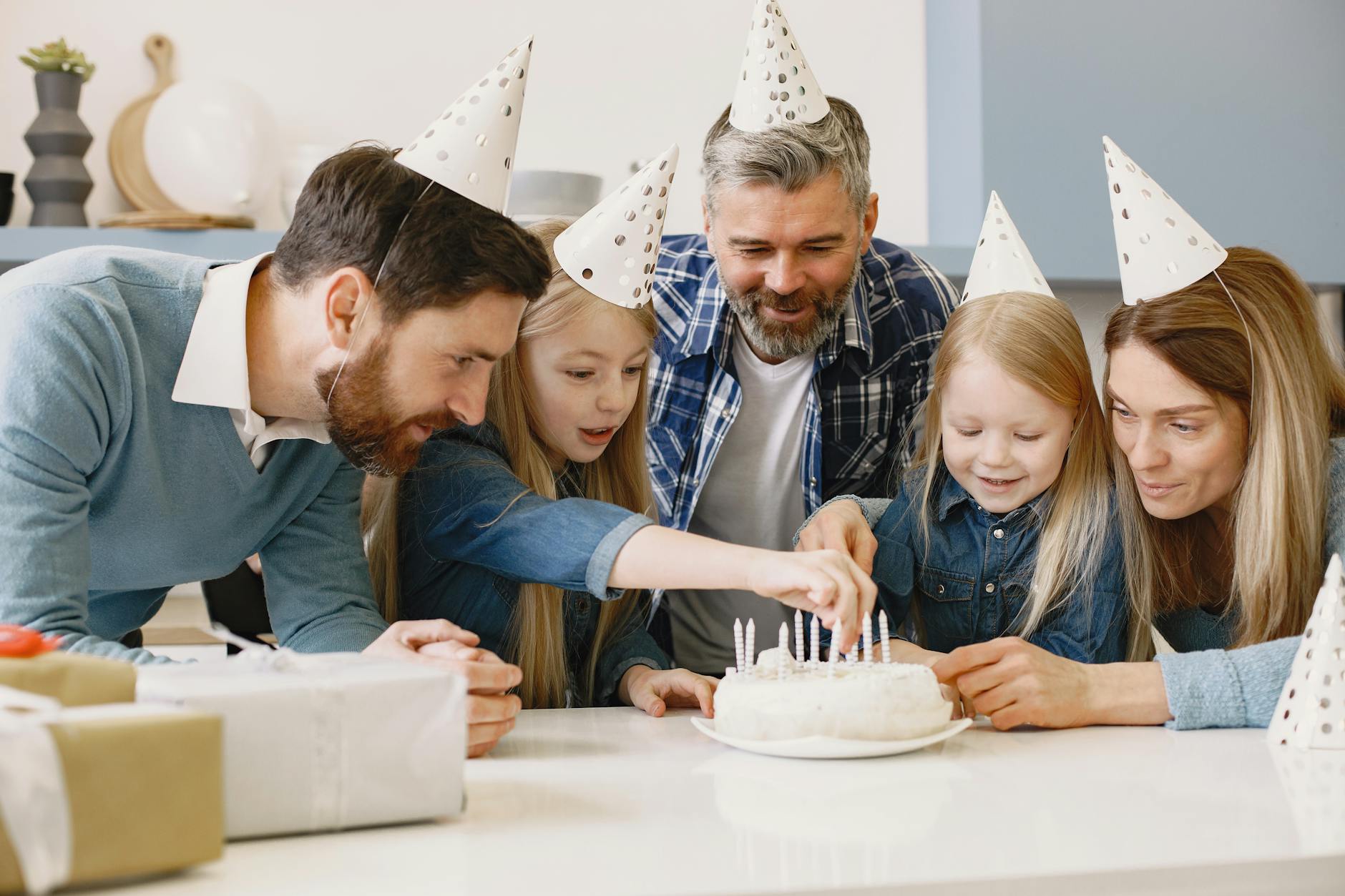
A review of 50 years of research on family rituals, published by the American Psychological Association (2002), found that family celebrations are positively linked to child adjustment, parenting competence, and marital satisfaction. In a clinical comparison, families in the healthy group shared significantly more celebrations than families whose children were receiving mental health treatment (p=0.00007, a finding so strong it borders on definitive).
That doesn’t mean celebration prevents all hardship. It means that being a family that marks occasions, that stops and acknowledges milestones together, builds something in a child that holds.
The peer dimension matters too. A 2024 study in Current Psychology (Springer) tracked 857 high school students and found that family rituals are positively linked to friendship quality, with the effect working through both perceived parental support and a sense of meaning in life. Children who grow up in families that celebrate tend to carry those skills outward. They know how to show up for other people because they’ve experienced others showing up for them.
In my house, birthday parties have always been partly about teaching my kids to celebrate other people. You can’t be a good guest at someone else’s birthday if you’ve never understood what it means to be the birthday person.
It Doesn’t Have to Be Elaborate
I know what the pressure looks like, so let me be direct about this.
You don’t need a themed venue, a three-tier cake, or a hired entertainer. I’ve done all of those things. I’ve also done a birthday that was takeaway pizza, a fairy light garland, and the three of us watching the birthday kid’s chosen film. That one is still talked about fondly, years later.
What children need from a birthday celebration:
- Someone to acknowledge that today is different
- Effort made on their behalf
- The feeling of being seen by the people they love
That can cost $30 AUD (around $20 USD) or $300 AUD (around $200 USD). The spend doesn’t determine the emotional outcome. What matters is the intentionality: you stopped, you marked the day.
Some of the most meaningful birthday gestures I’ve seen cost nothing. A parent who took the day off work just to be present. A grandparent who rang from overseas at exactly the right time. Siblings who made cards without being asked. Those are what get remembered.
If budget is tight, the ideas that genuinely work don’t require much. A backyard scavenger hunt, a favourite meal cooked at home, a film night where the birthday kid controls every choice completely. My kids have taught me that they want the day to feel theirs, not photographable. If you want specific ideas, I’ve put together a full list of birthday party ideas for kids that covers everything from simple at-home options to bigger celebrations when the budget allows.
And for parents who’ve hit the age where their child is becoming more particular about what kind of celebration they want, the sweet 16 planning guide is worth a look. The same principles apply, scaled up. At every age, what your child wants most is for you to take it seriously.
What Happens When Birthdays Go Unacknowledged
This isn’t meant to guilt anyone who has missed a birthday or keeps celebrations minimal. But the research on this side of the question is worth knowing.
A 2022 research thesis from the University of Tromsø (Arctic University of Norway) that examined the social impact of birthday celebrations found that receiving a birthday invitation is a significant social signal for children. When children don’t receive invitations to peers’ parties, or when their own birthday passes without acknowledgment, they register it as a statement about their standing in the group. Non-acknowledgment communicates something, whether or not that was the intention.
A child whose birthday goes unnoticed doesn’t just miss out on cake. They miss the experience of being the centre of genuine positive attention, even briefly. For children already uncertain about where they belong, that absence goes deeper than the day itself.
Some form of acknowledgment, however simple, sends a message worth sending: we know this day is yours, and we’re glad you’re here.
TL;DR
Birthday celebrations matter for children’s development in specific, documented ways. Acknowledgment builds self-esteem, anchors early autobiographical memory, and strengthens family bonds. The size and cost of the celebration doesn’t determine the outcome. Intentionality does. Research from the APA and peer-reviewed psychology journals consistently links family rituals and celebrations to better mental health outcomes, stronger peer relationships, and higher self-esteem in children. You don’t need a themed party. You need to stop and make the day theirs.
Frequently Asked Questions
Why is celebrating birthdays important for children’s mental health?
Birthday celebration is a form of acknowledged recognition that tells a child they are valued and their existence is worth marking. Research published by the American Psychological Association found that families who share more celebrations show significantly better mental health outcomes for their children than those who don’t. This works partly through the sense of belonging that celebrations create, and partly through the identity-anchoring effect of recurring rituals. Children who feel they matter to their family and social circle show lower rates of anxiety, greater self-esteem, and stronger peer relationships over time. The size of the event doesn’t determine this effect. The fact of acknowledgment does.
Does the size of the birthday party matter for kids?
Research on birthday celebrations is consistent on this point: size matters far less than presence. What children respond to is not the scale of the event but the intentionality behind it. Studies examining birthday party experiences found that the emotions associated with celebrations concentrate around feeling acknowledged and celebrated by people who matter, not around the number of guests or the cost of decorations. For many children, smaller gatherings with close family and friends feel more personally significant than large group events where they end up managing social dynamics rather than enjoying their day.
At what age do children start remembering their birthdays?
Research published in the journal Memory (2021) found that the average age of earliest memories is around 2.5 years old, a year earlier than previous estimates. Children’s memories are forming and consolidating throughout the preschool years, though what gets retained can shift over time. Researchers call this “telescoping”: early events get misdated to older ages, but the memories themselves are there. By age three or four, many children carry emotional memories of celebrations even if they can’t recall specific details. The repeated, ritualistic nature of birthdays, with the same songs, the same candles, the same structure each year, helps these memories consolidate more reliably than one-off events.
How can I make my child’s birthday special on a tight budget?
The most meaningful birthday elements don’t require significant spending. Focus on what creates the emotional experience: a decorated breakfast table when they wake up, their choice of dinner, a small gathering of their favourite people, and an activity they actually enjoy. A scavenger hunt, a movie night with full control of the remote, a baking session where they choose what to make. These land just as well as anything expensive. In my experience, children remember the feeling of the day more than any specific gift or venue. Give them your time and full attention, and let them lead. Aim for memorable over costly.
Is it okay to skip a child’s birthday celebration?
Occasionally, circumstances make a celebration impossible on the day itself: illness, travel, a family crisis. Shifting the celebration by a week causes no lasting harm. Consistently skipping birthdays without any acknowledgment is different. Research on social belonging found that children who experience repeated non-acknowledgment, whether from family or peers, register this as information about their importance within the group. That doesn’t mean you need an elaborate party every year. Some form of acknowledgment, however simple, sends a clear message: your birthday matters to us, and so do you.
The candles, the cake, the slightly off-key singing. None of it has to be perfect. It just has to happen.