
Most people stall for at least thirty seconds before writing a birthday card. You’ve got the card, you’ve got the pen, and suddenly your brain produces nothing more useful than “Happy Birthday!” and your name. I’ve done it hundreds of times, and I’ve finally figured out why: we’re trying to write something personal for a specific person in a specific relationship, but we’re working from a completely generic template in our heads.
What to write in a birthday card depends almost entirely on two things: who you’re writing to, and what kind of relationship you actually have with them. A message that would land perfectly with your best friend would make your manager deeply uncomfortable. The same message that makes your mum cry happy tears would completely miss the mark for a work colleague you’ve known for three weeks.
Below, I’ve laid out real, usable messages for six relationship types, plus a few personality-based variations within each. Copy them directly, tweak them, or use them as a starting point for something more personal.
TL;DR
- Birthday cards feel hard to write because most people try to use one generic approach for every relationship
- The best messages are specific to the person and the relationship, not the occasion
- For partners: lean into intimacy and shared history. For parents: gratitude beats sentimentality. For kids: make it feel big and personal to them
- For best friends: humour and specificity win. For colleagues: warm but brief. For new friends: light and genuine
- The “formula” that works for nearly every relationship: one real thing you appreciate about them + a specific wish for their year
- Download the Birthday Message Cheat Sheet below for a quick-reference version you can keep in your card drawer
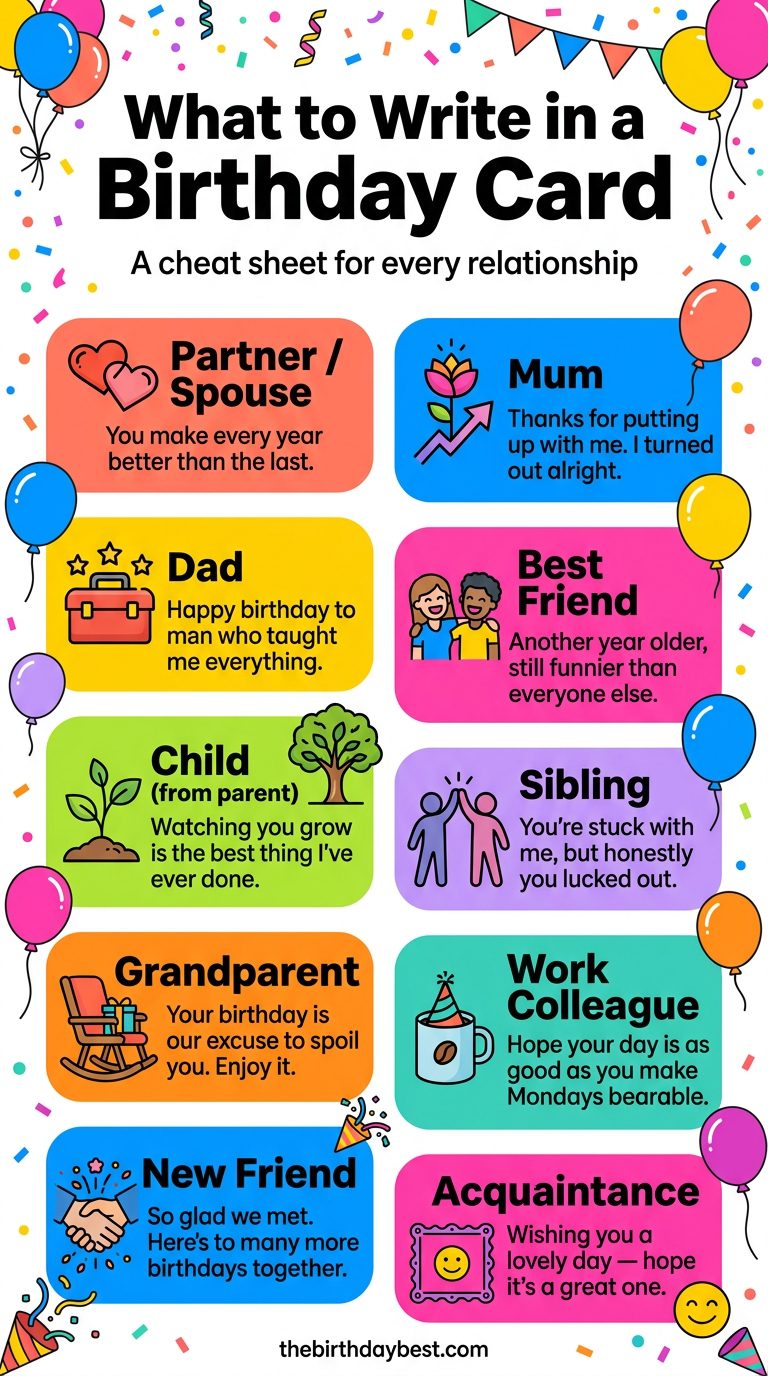
What Actually Makes a Birthday Message Land
A good birthday card message is one the recipient reads and thinks, “that’s actually me.” Specificity is the quality that separates a memorable card from a forgettable one. It doesn’t need to be long. It doesn’t need to be witty. It needs to feel like you wrote it for this person, not copied it from a template.
According to research by Amit Kumar and Nicholas Epley published in Psychological Science, people consistently underestimate how much a written message means to the person receiving it. Senders assumed their notes would feel awkward or ordinary. Recipients almost always felt warmer and more valued than the sender predicted. The gap is large enough that it should make anyone who hesitates over card-writing rethink the hesitation.
The Greeting Card Association reports that birthday cards account for around 60% of all everyday cards sold, with close to two billion birthday cards sent annually in the United States alone. That’s a lot of “Happy Birthday, from [name]” going out into the world. The ones that get kept are the ones that say something real.
Here’s the formula I actually use now: one specific thing I appreciate or love about this person, plus one genuine wish for their year. That’s it. Two lines can be enough if they’re the right two lines.
Card anxiety is the name I’d give to the paralysis most people feel when they pick up the pen. It’s real, and it’s caused by the same thing every time: trying to say something profound when what the person actually needs is something true.
What to Write in a Birthday Card for Your Partner or Spouse
Partners are simultaneously the easiest and hardest people to write for. You know them better than almost anyone, which means generic messages fall flat fast. But that same closeness gives you material no-one else has: shared history, inside references, real moments.
Skip the “you’re my everything” type of line. It’s true, but it’s also on a thousand cards they’ve seen before. Go specific instead.
Heartfelt
- “You make every ordinary Tuesday feel like it’s worth something. Happy birthday, love.”
- “Watching you do life has been the best thing I’ve ever had a front-row seat to. Happy birthday.”
- “I didn’t know what I was missing until you. I do now. Happy birthday.”
Funny (for partners with a good sense of humour)
- “Another year of putting up with me. You deserve a medal. Happy birthday.”
- “I love you enough to let you pick the restaurant tonight. Happy birthday.”
- “Still my favourite person to do absolutely nothing with. Happy birthday.”
The reference to something you’ve actually shared together will always outperform any of the above. Steal the structure, fill it with something real.
What to Write in a Birthday Card for a Parent
Parent cards trip people up because the relationship is so layered. You want to be warm without being gushy, grateful without being formal. The best parent cards I’ve ever written acknowledged something specific they did, rather than just how much I love them.
Since having my three kids, I’ve noticed I write to my own parents differently. I understand things now that I just accepted as normal before. That shift is worth putting in a card if you feel it.
For Mum
- “Thanks for all the things you did that I only understood once I had kids of my own. Happy birthday, Mum.”
- “You always made our house feel safe. I know now how much effort that took. Love you.”
- “I still call you first with news, good and bad. Happy birthday to the person I trust most.”
For Dad
- “You showed me what it looks like to work hard and still be present. That stuck. Happy birthday, Dad.”
- “I learned more from watching you than I ever realised at the time. Happy birthday.”
- “Thanks for answering the phone at odd hours without complaint. Still appreciated. Happy birthday.”
If your relationship with a parent is complicated, a short warm message is always better than a long one that tries to resolve things. “I’m glad you’re in my life. Happy birthday.” is complete on its own.
What to Write in a Birthday Card for Your Child
Kids remember birthday cards more than most parents expect. My eldest still has every card I’ve written him since he turned five, in a shoebox under his bed. He’s never told me he reads them, but I know he does because the box keeps moving.
The mistake most parents make is writing what they feel rather than what the child will connect with. A six-year-old doesn’t need to know they’re your greatest joy. They want to feel seen and celebrated for being specifically themselves.
For young kids (under 10)
- “You are [age] whole years old today. That is SO MANY years. We are so proud of you.”
- “Do you know what makes today extra special? YOU do. Happy birthday, [name].”
- “Being your mum/dad is the best job I’ve ever had. Happy birthday, gorgeous.”
For tweens and teens
- “I see how hard you work at [thing they care about]. It shows. Happy birthday.”
- “You’re becoming someone really good. I don’t say that enough. Happy birthday.”
- “Still my favourite [age]-year-old on the planet. Happy birthday, [nickname].”
With teens especially, specificity is everything. Name the thing they actually care about, not the thing you wish they cared about.
What to Write in a Birthday Card for Your Best Friend
Best friend cards are where you have the most creative licence, which is exactly why people overthink them. You know the relationship. You know the vibe. Trust that.
If your friendship runs on humour, write something funny. If it’s the kind where you’d both cry watching a rom-com, write something that earns the tears. The worst best friend cards are the ones that play it safe.
Warm and genuine
- “You are one of the few people I’d actually answer the phone for at midnight. Happy birthday.”
- “Thank you for being the person I call when things go sideways. And for the times they went right, too.”
- “I don’t have to explain myself to you, and that’s the rarest thing. Happy birthday.”
Funny and slightly savage (for the right friendship)
- “Another year of knowing you. Still my favourite bad decision. Happy birthday.”
- “You’re my favourite person to complain with. Happy birthday, legend.”
- “I was going to write something heartfelt but I know you’d mock me for it. Happy birthday.”
If your friendship runs hotter on the roast-side, I’ve put together a whole collection of funny insulting birthday wishes for best friends that go further without tipping into genuinely mean.
What to Write in a Birthday Card for a Colleague
Colleague cards sit in the most awkward middle ground: you want to be warm, but not overly personal. Professional, but not cold. The sweet spot is brief, genuine, and completely work-free.
The key rule for a colleague card: no mention of work, projects, targets, or anything they might want to switch off from on their birthday. Their birthday is the one day you’re legally required to pretend the job doesn’t exist.
For a colleague you like but don’t know well
- “Happy birthday! Hope your day involves zero spreadsheets and maximum cake.”
- “Wishing you a brilliant birthday. You deserve a day that’s 100% work-free.”
- “Happy birthday! Hope it’s a good one.”
For a colleague you’re genuinely fond of
- “You make the office genuinely more fun to be in. Happy birthday.”
- “Lucky to work with someone as decent as you. Happy birthday.”
- “Thanks for always making things feel less awful when they could be. Happy birthday.”
If you’re writing a card from the whole team, stick to the first category. Keep it breezy and inclusive. If it’s just from you and you have a real work friendship, the second category gives you a bit more to work with.
What to Write in a Birthday Card for a New Friend
New friendships are still finding their tone, which means the card has to work without relying on shared history you don’t yet have. The goal here is warmth without intensity, genuine without trying too hard.
I’ve made the mistake of overwriting for new friends, trying to pack in appreciation that would be appropriate for a three-year friendship but reads oddly when you’ve known someone for four months. Shorter is usually safer when the relationship is still settling.
- “So glad we ended up in each other’s orbits. Happy birthday!”
- “Really happy we became friends this year. Hope your birthday is brilliant.”
- “Wishing you a brilliant birthday. Here’s to more [thing you’ve done together] soon.”
That last one works well if you can name something specific: “more Saturday morning walks” or “more terrible trivia nights” lands better than a generic wish. If you’re also buying a gift, this article on birthday gift ideas for a new friend covers what actually works at this stage of a friendship without going overboard.
A Formula That Works Across Every Relationship
If you’re still stuck, here’s the structure I fall back on for any relationship:
- One specific thing you appreciate about them (not a general compliment, something real)
- One genuine wish for their year ahead (not “hope your dreams come true”, something concrete like “hope you finally get that trip to Portugal” or “hope this year has more of the good stuff and less of the hard stuff”)
- Your sign-off (matched to the relationship: “love” for close family and partners, “cheers” or “warmly” for colleagues, “your mate” for friends who’d roll their eyes at anything formal)
That’s genuinely all you need. Three things. It takes about two minutes to write and will be remembered far longer than a pre-printed verse that cost you nothing but the card price.
Frequently Asked Questions
What do you write in a birthday card when you don’t know the person well?
Keep it brief and warm. “Happy birthday! Hope you have a wonderful day” is completely acceptable and far better than an overwrought message that doesn’t fit the relationship. Add their name to personalise it slightly. If you know one specific detail about them (their favourite food, an upcoming trip), referencing it makes the message feel considered without requiring deep familiarity.
How long should a birthday card message be?
Two to five sentences for most relationships. More than that and the card starts to feel like a letter, which can be wonderful for very close relationships but uncomfortable for anyone you see professionally or don’t know well. The length should match the depth of the relationship: a best friend of twenty years might warrant a full card. A neighbour you wave to probably doesn’t.
Is it okay to write a funny birthday message?
Yes, as long as you know the person well enough to gauge it correctly. Humour works best in cards for best friends, partners, and siblings who share your sense of humour. It’s risky for colleagues you don’t know well, parents with whom you have a more formal dynamic, or anyone who might read the joke differently to how you intended. When in doubt, lead with warmth and save the roast for the pub.
What should you never write in a birthday card?
Anything that makes the message about you rather than them. Comments about their age that might sting rather than amuse. References to things they’re struggling with (job stress, relationship trouble, health issues) unless you’re specifically acknowledging those struggles with support. And the generic pre-printed verse on its own with just your name signed under it. Add at least one handwritten line to show you were actually there.
Can I write “Happy Birthday” and nothing else?
For a casual acquaintance or a work colleague you don’t know well, yes. A signed card is still a gesture. For anyone you’re close to, add at least one personal line. Blank card syndrome is real (according to a GCA survey via the US Chamber of Commerce, February 2025, even the greeting card industry acknowledges that the message matters more than the card design itself). One genuine sentence beats five generic ones.
How do you write a birthday message for someone going through a hard time?
Acknowledge where they are, briefly. “I know this year has been a tough one, and I just wanted to mark the day and let you know I’m thinking of you” is honest and kind. Don’t ignore the elephant in the room with relentless cheerfulness, because it can feel dismissive. But equally, a birthday card isn’t the place to unpack everything. Keep it brief, warm, and grounded in the fact that you see them and you’re glad they exist.
Quick-Reference: Message Starters by Tone
If you know the tone you want but not the opening, here are starters sorted by register:
| Tone | Starter | Best for |
|---|---|---|
| Heartfelt | “I don’t say this enough, but…” | Parents, long-term partners, close friends |
| Warm and simple | “Really happy to be celebrating you today…” | Any relationship |
| Funny/light | “Another year of putting up with [me / the world / all of us]…” | Best friends, partners, siblings |
| Professional warmth | “Wishing you a brilliant birthday…” | Colleagues, clients, acquaintances |
| Parental pride | “Watching you become who you are…” | Your kids, godchildren, nieces/nephews |
| New friendship | “So glad our paths crossed this year…” | New friends, newer acquaintances |
Birthday cards get kept or thrown away based on whether they say something true. The printing, the design, the glitter envelope: none of that matters as much as the two lines you wrote by hand inside. If you’ve got this far and still feel stuck, go back to basics: what’s one real thing you’d want this person to know they meant to you this year? Write that. Sign your name. That’s the card.
And if you want to pair your card with something they’ll actually remember, there’s always the option of giving an experience instead of (or alongside) a wrapped gift. The best birthday experience gifts article covers options from under $30/AUD$45 all the way up, sorted by relationship and budget.